
Vedi sotto per la versione inglese /See below for the English version
Nell’inesauribile storia della ricezione dell’Antigone di Sofocle, la figura di Ismene non ha avuto un destino molto fortunato.
Di solito la si è considerata l’alter ego negativo della sorella Antigone, l’indomita eroina ribelle che sfida la prepotenza del potere senza il minimo tentennamento e a rischio della propria vita. Ismene, invece, ha simboleggiato a lungo la posizione di chi passivamente accetta lo status quo, fino ad essere quasi schernita per la sua paura: è capitato per esempio da parte di importanti interpreti donne e femministe, che hanno santificato Antigone quale antesignana della sfida al patriarcato e dell’emancipazione femminile, mentre hanno accusato la sorella conformista di sottomettersi al potere maschile e maschilista, personificato da Creonte. Un esempio su tutti è quello della grande pensatrice della differenza sessuale, Luce Irigaray, che nel suo libro fondativo Speculum, l’altra donna (pubblicato nel 1974 in francese e tradotto in italiano l’anno dopo a cura di Luisa Muraro) presenta Ismene quasi come una caricatura, stereotipo della donna e del femminile remissivo impostosi nella tradizione culturale androcentrica dell’occidente: «Ismene appare incontestabilmente come donna, e questo anche per la sua debolezza, la sua paura, la sua obbedienza docile, le lacrime, la follia, l’isteria»[1].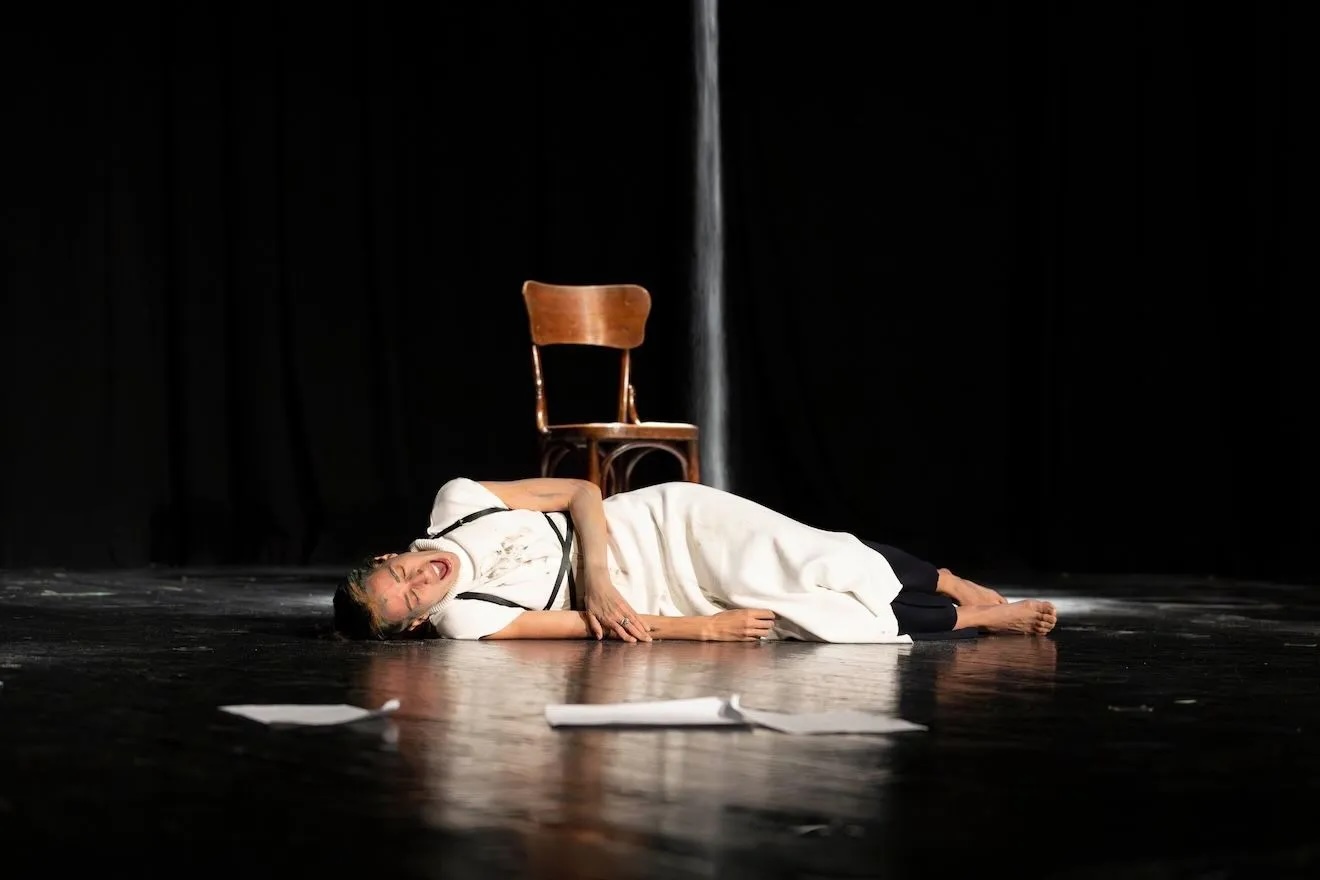
Negli ultimi anni, tuttavia, diverse riletture e riscritture della tragedia hanno rivalutato la figura solo apparentemente secondaria della ‘mite’ Ismene, fino a ribaltare completamente l’interpretazione classica. Si possono ricordare almeno due drammi: Zus van (‘Sorella di’, 2005), dell’olandese Lot Vekemans, e Pale Sister (2019) dell’irlandese Colm Tóibín[2]. Ismene ritorna ora alla ribalta anche nel recente e affascinante monologo teatrale della pluripremiata drammaturga canadese originaria di Montreal Carole Fréchette intitolato significativamente Ismene e pubblicato per la prima volta in francese nel 2023[3].
L’autrice, classe 1949, ha un passato da attrice, ed è stata attiva nel teatro femminista del Quebec degli anni ’70, soprattutto all’interno del collettivo teatrale Theatre des cuisines, partecipando a spettacoli che rivendicano i diritti delle donne, come per esempio Nous aurons les enfants que nous voulons, sul diritto all’aborto. A partire dalla seconda metà degli anni ’80 si è data invece alla scrittura drammatica, e da allora non ha smesso di scrivere pièces teatrali, pubblicandone più di una ventina e ottenendo numerosi riconoscimenti, tra cui il Siminovitch Prize (2002), il più importante premio letterario del Canada, e il Prix du Gouverneur Général du Canada, per due volte (1995, Les Quatre morts de Marie; 2014, Small Talk). È stata inoltre tra i finalisti del prestigioso Grand Prix de Littérature dramatique nel 2009 e nel 2022.
La più parte delle sue opere hanno per protagonisti personaggi femminili, spesso ai margini della società, cui Carole Fréchette restituisce la voce, come avviene proprio nel caso di Ismene. È inoltre autrice di tre romanzi per adolescenti, uno dei quali tradotto in italiano da Luca Scarlini: Do come Dolores (Milano, Buena Vista, 2006): è la storia di un’amicizia tra due ragazze che si trasforma in un giallo intrigante. La gran parte delle sue opere teatrali sono state tradotte in numerose lingue e portate in scena in diversi paesi del mondo, tra cui Canada, Stati Uniti, Francia, Germania, Belgio, Inghilterra, Spagna, Portogallo, Grecia, Islanda, Israele, Giappone. Purtroppo l’autrice ha ricevuto finora pochissima attenzione in Italia, e meriterebbe di essere tradotta e portata in scena di più[4].
L’Ismene della Fréchette cui abbiamo assistito è andata in scena ad Atene dal 7 marzo scorso per circa un mese ogni sabato e domenica presso il teatro Arroyo nella messa in scena del regista e docente di studi teatrali Manolis Seiragakis. La versione in greco moderno della pièce è stata tradotta dal francesista Dimitris Filias per i tipi dell’editore Liotrivi-Panagiota G. Sarafi[5]. Si è trattato del debutto ateniese dopo la première del 19 novembre 2024 durante il Festival Internazionale del Libro di Tripoli, nel Peloponneso, dove il monologo era stato inscenato dalla compagnia teatrale cretese Antivaro di Rethymno co-fondata dallo stesso stesso Seiragakis.
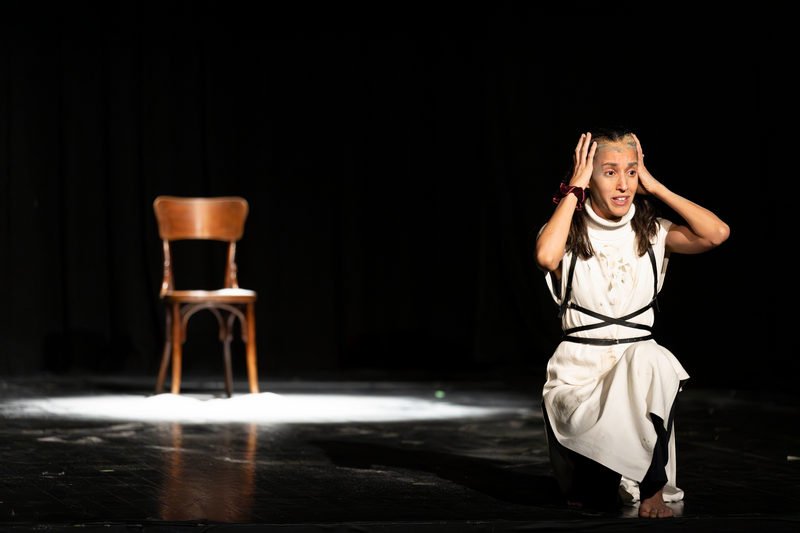
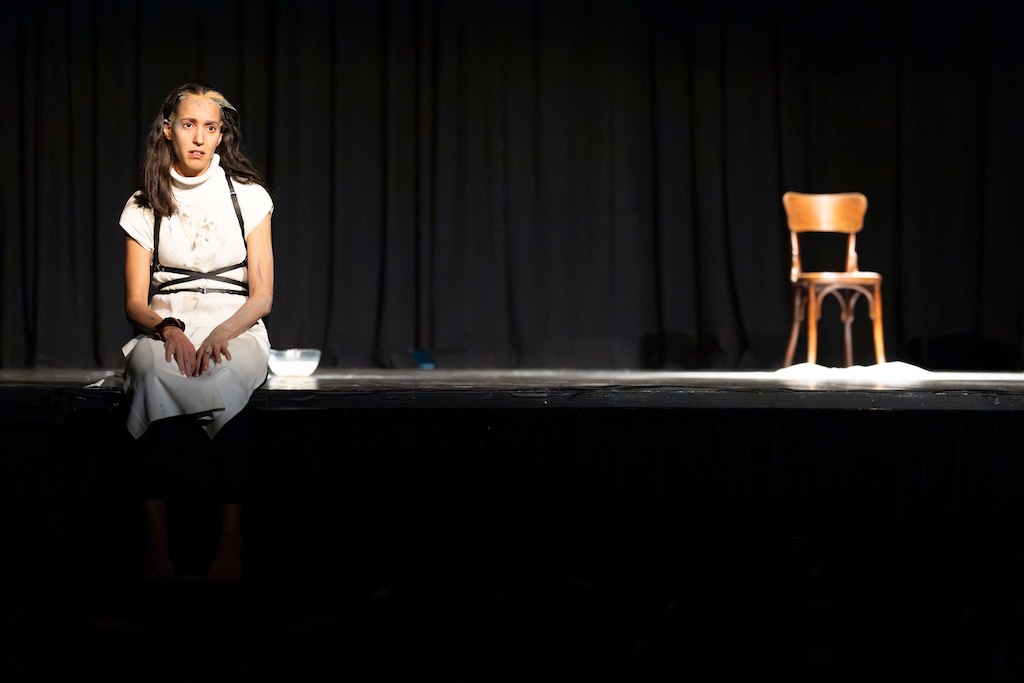
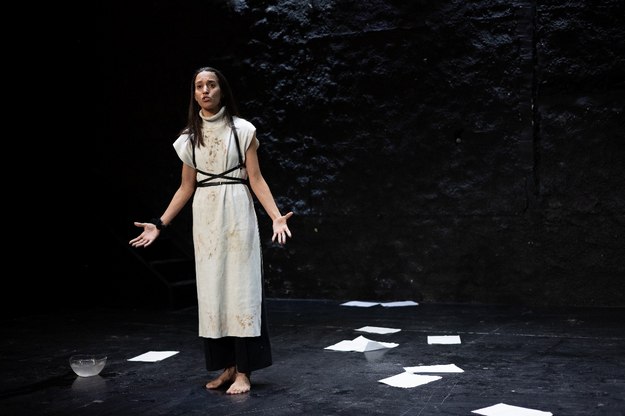
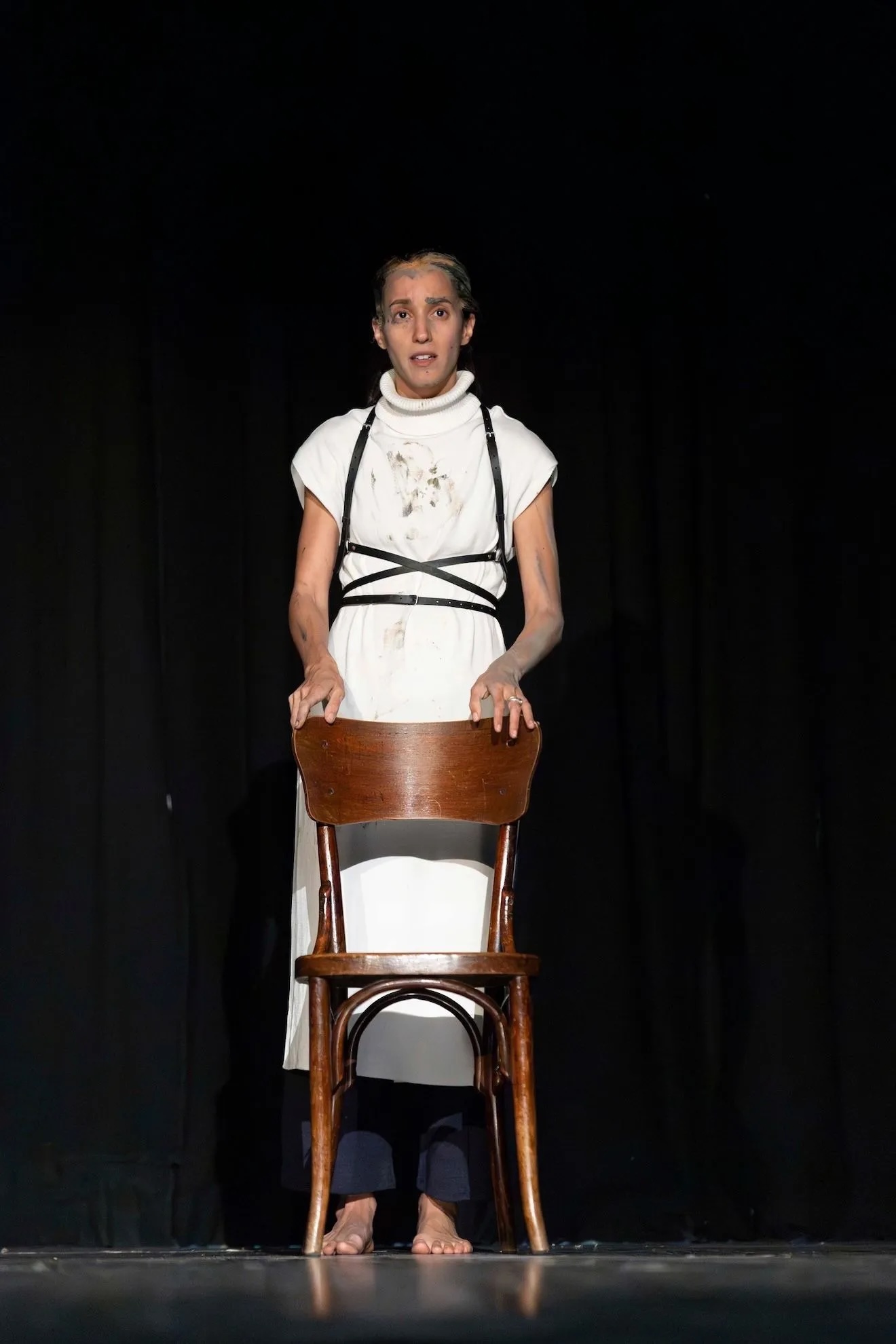
Ismene appare sola in scena, a darle voce e corpo è la giovane ed emergente attrice greca Elettra Fragkiadaki, in un’interpretazione molto bella che riesce ad essere insieme intensa e delicata. La scenografia è spoglia e minimalista, e rispecchia la sobria ma decisa indole della protagonista: ogni gesto fisico e verbale di Ismene, infatti, pur essendo discreto, acquista un peso essenziale nella riscrittura della drammaturga canadese.
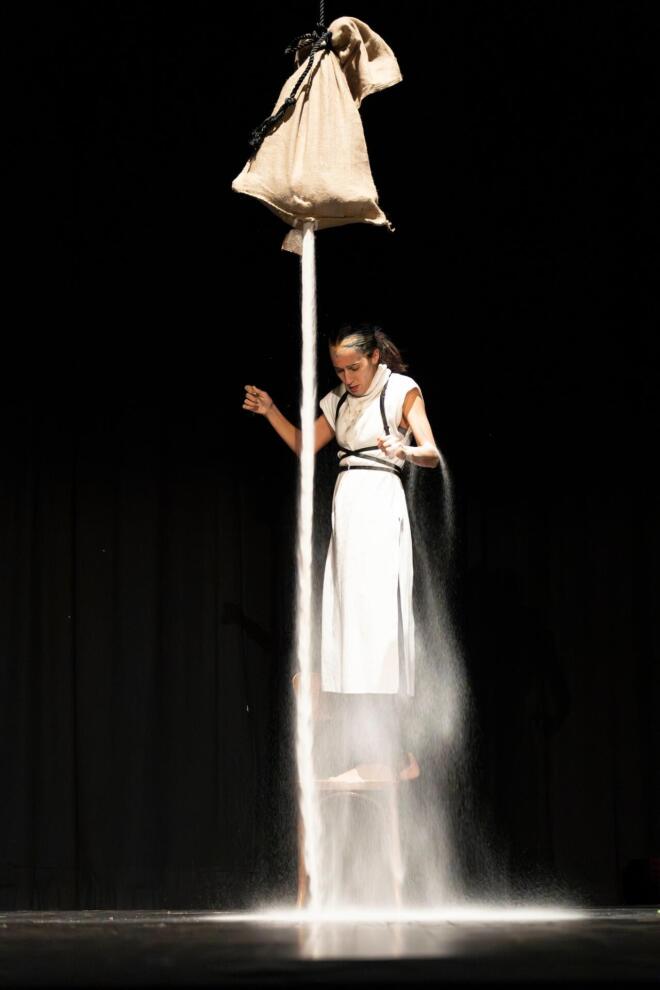
Vestita d’un semplice chitone dorico senza maniche, Ismene è accompagnata soltanto da una sedia, un tavolino con un bicchiere d’acqua e dei fogli dove ha scritto degli appunti per la propria personale ‘presentazione’ degli antichi e tristemente famosi eventi del mito. Gliela ha commissionata un gruppo di persone indeterminate che si dicono affascinate dalla sua storia e pensano che la sorella di Antigone «non abbia ricevuto tutta l’attenzione che merita». L’unico altro oggetto presente che si vedrà in scena è un sacco ocra pieno di polvere sospeso sopra la sedia e da cui sarà fatta cadere la polvere bianca, simbolo della sepoltura di Polinice, ma anche della morte che Antigone si darà da sé appendendosi a un laccio nella caverna. Il palco, piuttosto piccolo, taglia in due la sala del teatro dove il pubblico è seduto su dei gradoni molto ravvicinati da entrambe le parti del palcoscenico.
Ismene si rivolge agli spettatori con un prosaico ‘Buonasera’, che imposta dalla prima battuta il tono dell’intero monologo scritto in modo semplice e diretto, quasi un’autoconfessione intima del personaggio, ma non per questo monotono, anzi ricco di tantissime sfumature emotive che vanno dalla tristezza alla rabbia, dall’incertezza alla protesta, dalla sconsolatezza alla speranza.
L’autrice canadese ridà infatti la parola al personaggio cui Sofocle aveva assegnato poche battute nella tragedia: Ismene ha così finalmente modo e tempo di rivivere e raccontare dal suo punto di vista tutti i fatti ben noti e familiari non solo della trama dell’Antigone di Sofocle ma della storia dei Labdacidi, ossia della famiglia maledetta di Edipo, figlio-marito di Giocasta, e dei loro figli: i due fratelli Eteocle e Polinice, e le due sorelle Antigone e Ismene.
Il registro colloquiale rende la protagonista vicina al pubblico, che appare nello stesso tempo una figura del mito antico ma anche una donna contemporanea. Piena di dubbi ed incertezze, Ismene si erge da sola sul palcoscenico: uno spazio tutto suo dove poter essere ascoltata e presa sul serio e da cui rivendicare le proprie ragioni, che, come vedremo, sono quelle di una giovane donna che ha voluto scegliere la vita e la fine della catena della vendetta di fronte a una situazione di morte e di guerra. Non c’è bisogno di sottolineare l’acuta attualità di questo tema rispetto ai tragici e tristi eventi contemporanei.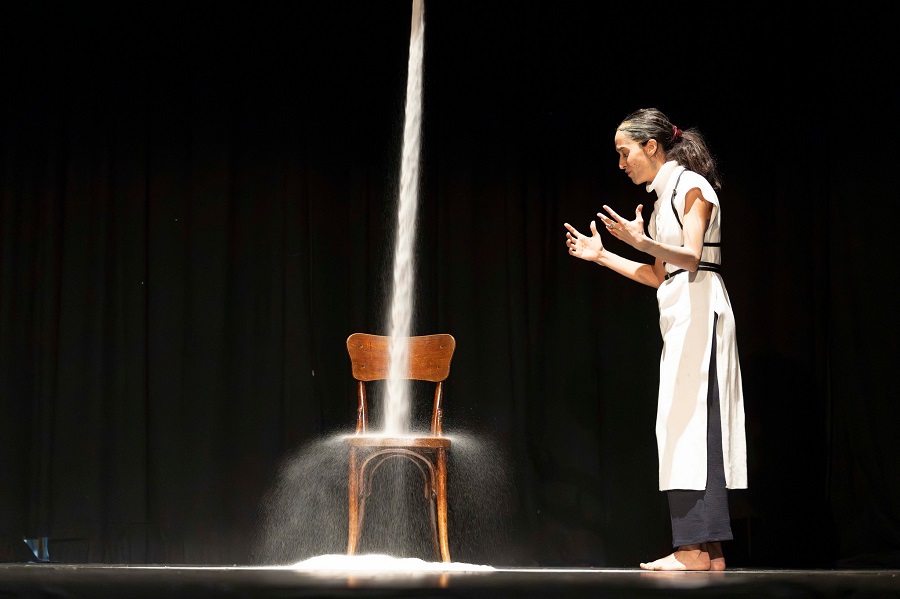
Le prime battute del monologo sono provocatorie e significative: Ismene spiega che le era stato richiesto un titolo per la presentazione ma che ha deciso di non fornirlo. Ha chiesto alle persone che la hanno invitata a parlare di trovarne uno loro perché ‘si fida di loro’:
Sono fatta così.
Mi fido.
Delle autorità, di chi è al comando, degli esperti.
Alcuni la chiamano sottomissione.
Io dico: mi fido.
È la mia posizione di default.
È l’espressione giusta?
Per impostazione predefinita, di default, io mi fido
L’antica accusa di sudditanza e di viltà che pesa sulla sorella minore dell’Antigone – ben sintetizzata nelle parole del poeta Stefano Raimondi come «la violenza del silenzio, dell’inazione»[6] – viene dunque fin da subito messa in crisi dall’autrice canadese.
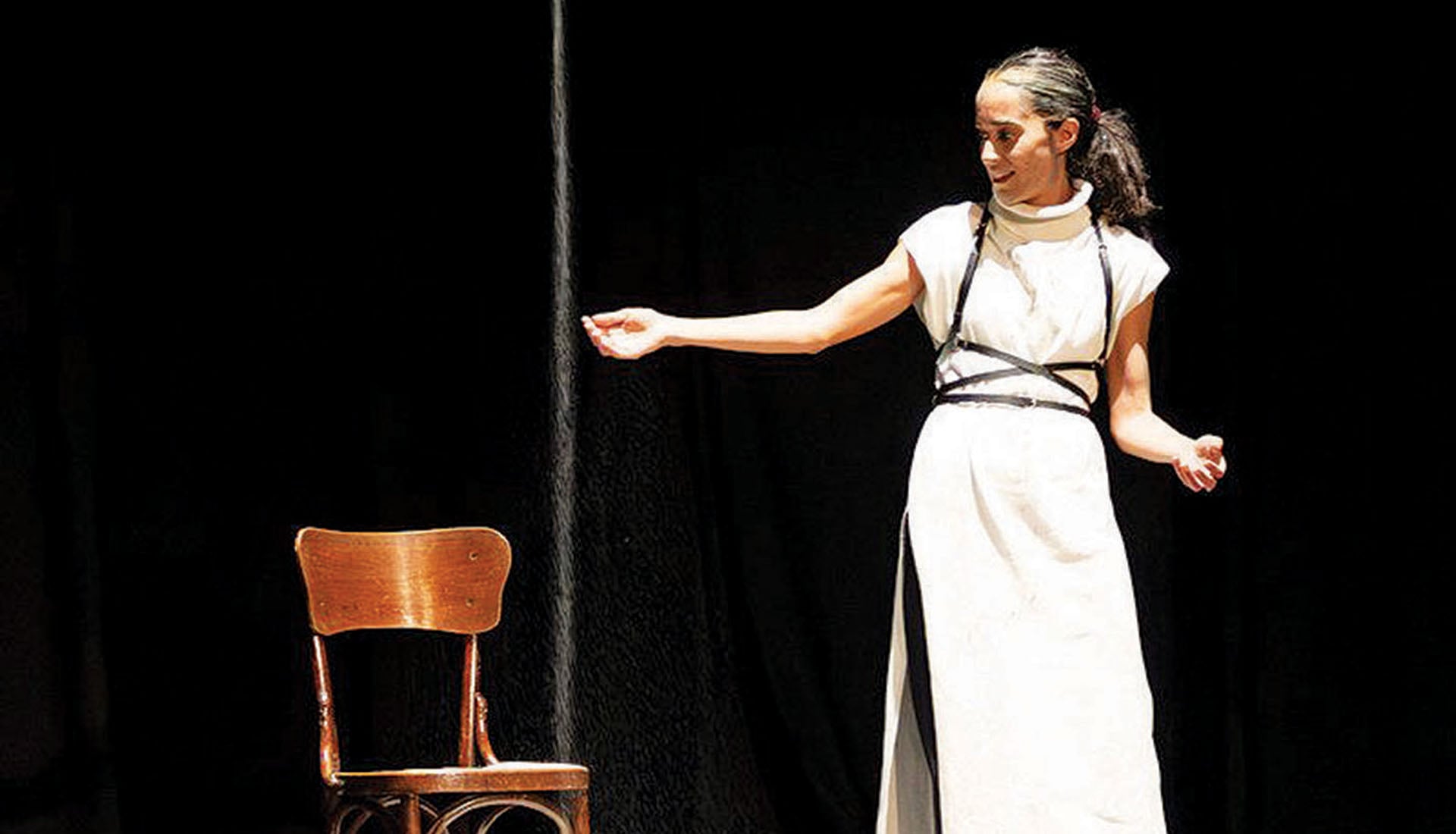
Stabilita l’importanza originaria della fiducia reciproca nelle interazioni umane, Ismene reclama poi la sua autonomia. Racconta di aver scritto all’inizio delle sue note, per presentarsi, le espressioni «sono la figlia di», «sono la sorella di», ma di aver cancellato e sostituito con «sono greca», rivendicando un inizio ex-novo della propria storia non più dipendente dai suoi familiari molto più celebri della saga mitica, come si affretta a ricordare al pubblico: il padre Edipo che si cavò gli occhi saputo di aver sposato sua madre; la madre Giocasta impiccatasi dopo la stessa scoperta; i due fratelli morti in una guerra fratricida; e naturalmente Antigone:
Tutti conoscono il suo nome.
Già mi guardate in modo diverso.
State pensando: ah, è la sorella di... è la figlia di...
Il primo episodio mitico che Ismene rievoca nel monologo è la contesa per il dominio su Tebe dei suoi due fratelli che provoca l’aggressione militare di Polinice contro Eteocle e la morte di entrambi l’uno per mano dell’altro. Si tratta di un flash-back sull’evento che costituisce la premessa dell’Antigone ma a cui Sofocle fa solo sparuti, anche se significativi, accenni nel dramma antico. Si stagliano così davanti al pubblico i tentativi di rappacificazione di Ismene, le sue implorazioni concitate ai due fratelli:
Correvo dall’uno all’altro.
Dicevo: ascoltatevi. Vi dovete parlare.
Non posso scegliere tra uno di voi due.
Siete i miei fratelli.
Voglio che facciate pace. Entrambi.
Qui e poi in tutti i dialoghi successivi le doppie voci e il confronto fisico delle coppie di personaggi sono resi in scena dall’attrice ancor più che attraverso la modulazione verbale dalla gestualità nitida dell’oscillazione delle braccia e delle mani, carica di eloquente essenzialità (lo si può vedere anche nel trailer dello spettacolo).
Tuttavia Ismene appare ingenua ad Eteocle e Polinice e incapace di comprendere la logica del potere, che impone scelte di parte che a loro volta sono destinate a portare al conflitto, anche in forme di estrema violenza. La protagonista si sofferma in particolare sulla descrizione dei dettagli orrorifici che la guerra comporta con una serie di immagini crude introdotte da un preciso e intenso richiamo metateatrale da parte della drammaturga alla recente spirale di tensione e frenesia bellica:
La guerra è scoppiata.
Si dice così «la guerra è scoppiata» e poi si continua il racconto,
come se fosse un dettaglio. Come se si dicesse:
è scoppiato un temporale e poi è tornato il bel tempo.
Io dico: la guerra è scoppiata, e faccio una pausa.
Non so che cosa significhi questa parola per voi oggi.
A quel tempo, per gli esseri umani voleva dire...
Compare a questo punto un momento di felice inventiva simbolica della drammaturga, che recupera un elemento tipico della cultura greca antica e spesso presente nelle tragedie: la preghiera alla divinità in un tempio o presso un altare. Scopriamo così che Ismene in quei giorni tesi di allarme per la guerra civile alle porte era corsa presso il tempietto di Eirene, la ‘Pace’, dove il viso della statua della dea che teneva in braccio un bambino appariva «pieno di dolcezza». E veniamo anche a sapere che invece la dea preferita da Antigone era Atena, patrona della sapienza e della ragione ma anche della «guerra giusta». Alle preghiere inascoltate di Ismene segue poi la narrazione breve e intensa dello scontro fratricida, ma prima la malinconica rassegnazione della protagonista dà sfogo a una serie di domande che risuonano tra le più forti e significative della pièce:
Chi vuole la pace? Per davvero?
Chi è disposto a sacrificare qualcosa sull’altare di Eirene?
Chi è disposto a perdere qualcosa per preservare l’armonia?
Perdere potere, territori, possedimenti, perdere l’onore?
Perdere è una vergogna, no?
E dove si traccia il confine tra compromesso e vigliaccheria?
Come si vedrà meglio tra breve, è chiaro che la drammaturga canadese sposa la tesi di quanti hanno letto i tentativi di mediazione di Ismene nell’Antigone in chiave positiva, ricreandone un ulteriore esempio nell’episodio che precede il dramma di Sofocle, quello del conflitto intestino tra Eteocle e Polinice. L’invito è quello di provare a trovare punti di accordo, a cercare il dialogo e la via mediana del compromesso, a evitare posizioni inconciliabili frutto di un orgoglio ostinato e sterile, accecato in questo caso dalla sete di potere. Si tratterebbe certo di una soluzione precaria e imperfetta, ma pragmaticamente efficace nell’evitare il potenziale distruttivo e autodistruttivo della violenza, se venisse pratica.
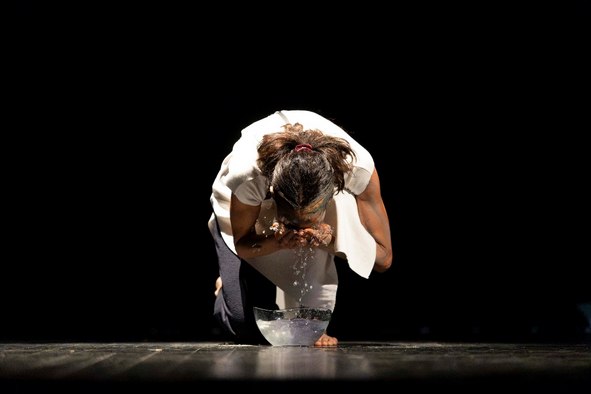
Ismene prosegue ininterrotta il suo racconto, in cui sono sempre le tonalità emozionali ad essere protagoniste, e dove l’attrice si esprime al meglio tra cambi di intonazione, improvvisi mutamenti nel volume della voce e semplici ma potenti movimenti nello stretto ma concentrato spazio scenico tra i due spalti degli spettatori. Confessa sconsolata che la visione dei corpi esanimi e intrecciati di Eteocle e Polinice – una mostruosa creatura: due teste, quattro gambe, quattro braccia – e il dolore che l’hanno sconvolta le hanno anche tolto le lacrime e la capacità di provare ora amore per i due fratelli.
Iniziano a questo punto le sequenze che ripercorrono la trama dell’Antigone di Sofocle. La prima scena è il celebre dialogo iniziale tra le due sorelle. L’ interessante operazione di Carole Fréchette è quella di seguire il testo sofocleo, traducendone letteralmente dei passi, ma di espanderlo attraverso i ricordi e le riflessioni della protagonista: si crea così un metatesto dove l’autrice può dialogare con il poeta antico, commentarlo, approfondirne gli spunti lasciati inespressi. Un esempio significativo è quello dei vv. 31-32 in cui Antigone riferisce alla sorella il bando di Creonte che ordina di lasciare insepolto il corpo Polinice, il fratello traditore ed aggressore di Tebe:
E Antigone mi ha detto «questo divieto si rivolge a tutti. A te come a me!».
E ha aggiunto «Anche a me!».
Mi ricordo di questo «Anche a me!», che ha quasi urlato.
Come se non potesse credere che Creonte le facesse un tale affronto: a lei, a Antigone.
Come se tutto fosse soltanto una questione personale tra lei e lui.
Nel seguito del colloquio tra le due sorelle si tocca uno dei momenti chiave della pièce, in cui Ismene esprime a chiare lettere la sua visione del mondo, e attraverso cui la drammaturga canadese lancia un forte messaggio etico e politico. Il personaggio è combattuto nel suo odio-amore per Antigone, della quale condivide i principi su un piano generale, ma non la messa in atto pratica degli stessi se ciò comporta conseguenze deleterie sia per i singoli che per il bene collettivo. La protagonista rivive sul palco con grande intensità l’accusa di non volere collaborare a seppellire Polinice per paura che Antigone le rinfaccia in modo aspro e violentemente. Si sente ferita, esclusa, ma non per questo demorde, anzi esprime le proprie ragioni, protesta e accusa a sua volta la sorella con una serie di domande incalzanti, che l’attrice pronuncia quasi gridando con virulenza:
Tu non mi ascolti, tu non mi ascolti mai.
Perché tu SAI. Tu sai cosa è giusto. Ma come...
Come puoi affermare con una certezza così totale che le leggi degli dèi
sono più importanti di qualsiasi altra cosa?
Come non puoi domandarti, neppure per una frazione di secondo, se non si debbano stabilire
delle regole per poter vivere insieme?
Come puoi non avere neanche un dubbio, non metterti nei panni di chi deve governare,
non tentare almeno di discutere?
Da dove ti viene questa certezza assoluta?
Il punto di massima intensità arriva però subito dopo, quando Carole Fréchette fa rispondere la sua eroina minore a quella che da sempre è stata l’imputazione più pesante nei suoi confronti. Quella di giustificare il timore e l’impotenza ad agire per il fatto di essere donne, e come tali incapaci di lottare contro un uomo e i suoi decreti (cf. Ant. 61-62 «bisogna anche considerare che siamo nate donne / che non abbiamo la forza per lottare contro gli uomini):
Tutto quello che volevo dire è:
forse noi siamo investite di un’altra missione:
quella di perpetuare la vita, di preservare il vivente.
È così orribile pensare una cosa del genere?
Se non preserviamo la vita noi, chi lo farà? Certamente non i nostri fratelli.
Ne ho abbastanza dei tuoi ‘aut aut; o la pensi come me o sei una vigliacca’.
Questo mi soffoca. Tu mi soffochi, Antigone!
Ismene rivendica da un lato le ragioni della saggezza pratica, ovverosia il dubbio, il compromesso, il dialogo, l’immedesimazione nell’altro, l’accettazione della vita nelle sue imperfezioni senza volere sempre e a tutti i costi che le cose siano perfettamente corrispondenti ai propri ideali. Dall’altro lato – e sta qui la novità maggiore di questa Ismene – la vera motivazione di fondo, il vero discrimine è quello tra chi sceglie in favore della vita e dei vivi, ossia il benessere e il futuro di una vita pacifica in comune, e chi invece sacrifica tutto, persino le persone vive e amate, in nome di un principio astratto di giustizia per la difesa del diritto di un morto. Si tratta delle famose ‘leggi non scritte’ di cui Antigone si fa irremovibile paladina, che sono però le leggi di Ade, del dio dei morti e che costringono la protagonista della tragedia sofoclea ad essere legata più alla morte e ai ‘suoi’ morti – quelli della sua famiglia incestuosa – che alla vita e alle altre persone vive, in primis la stessa sorella, e il fidanzato Emone.
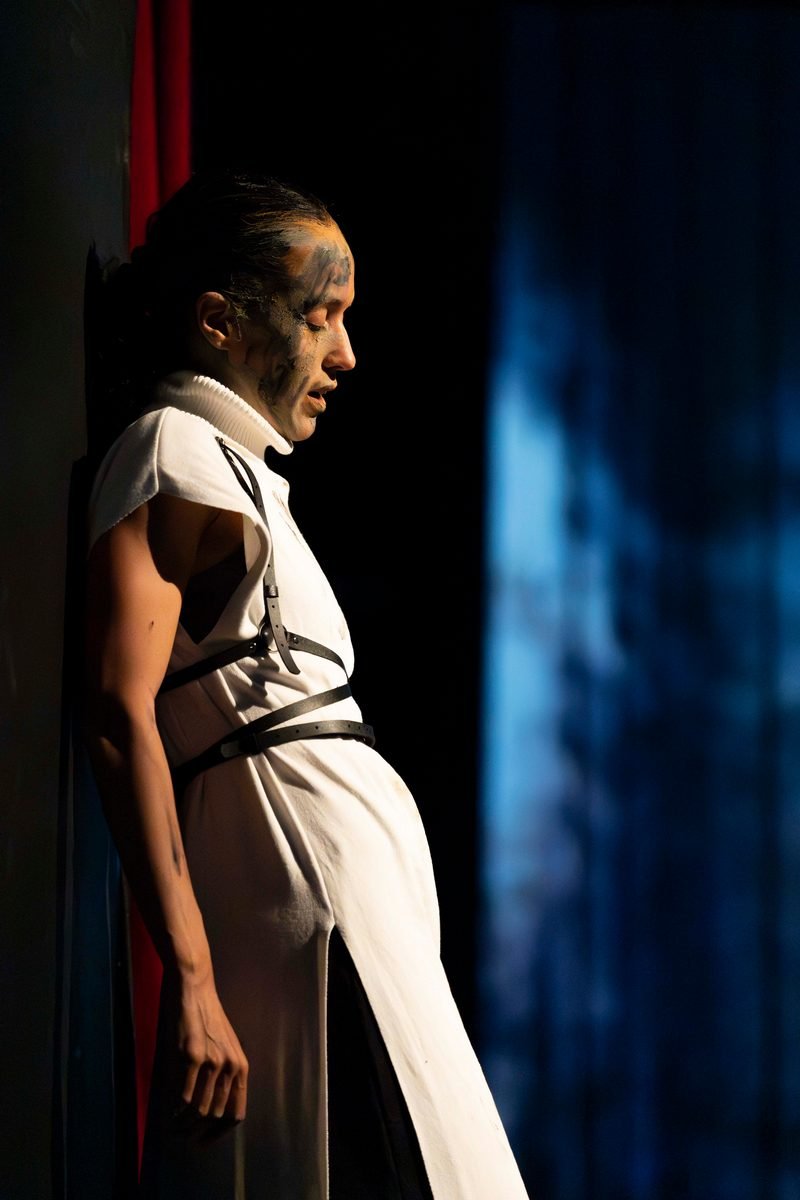
Il tema della saggezza pratica come antidoto all’assolutismo dogmatico e rovinoso di Antigone e di Creonte quale monito di fondo dell’Antigone di Sofocle ha infatti già avuto in passato diversi illustri sostenitori, tra cui si possono ricordare il grande pensatore francese Paul Ricœur, la filosofa americana Martha Nussbaum e in Italia il giurista ed ex-presidente della corte costituzionale Gustavo Zagrebelsky[7]. L’enfasi sul tema della difesa della vita, almeno a livello di ricezione teatrale, è invece sicuramente originale. L’importanza della tematica della vita in opposizione alla morte è d’altronde chiara dall’immagine della locandina scelta per lo spettacolo, che corrisponde anche alla copertina del libro nella traduzione greca. Vi si vede il mezzobusto dell’attrice nuda vista di profilo, con la pelle ricoperta di un materiale argilloso marrone verde e grigiastro – i colori della terra – e avvolta da alcuni ramoscelli di un albero, chiaro simbolo della fecondità della natura e della generazione della vita. Non è tuttavia la prima volta che la figura di Ismene viene letta in questo modo. La filosofa contemporanea Mary C. Rawlinson, esponente della teoria critica e del pensiero femminista, aveva già dato un’interpretazione simile a quella della drammaturga canadese. L’autrice in un saggio del 2014[8] poi riproposto come capitolo nel libro Just Life del 2016 ha sostenuto con forza le ragioni ‘per la vita’ di Ismene. Malgrado la Fréchette non sembri conoscerla, l’interpretazione filosofica tracciata dalla Rawlinson sembra chiarire nel modo migliore proprio il senso di questa recente Ismene e conviene allora citare qualche passo della filosofa:
«Di tutte le calunnie e le condanne accumulate sul conto di Ismene, solo una è vera: come lo schiavo di Hegel, rimane attaccata alla vita. Solo Ismene mostra quella fluidità e generosità d’animo che rifiuta di sacrificare le relazioni con i corpi umani in carne e ossa a principi astratti o all’orgoglio dell’autorità. Non perde mai la calma con nessuno. È riservata invece che impaziente, conciliante invece che rigida. È l’unica a non essere colpevole di aggrapparsi ostinatamente, con cuore e mente, a un diritto avventato e intemperante. Ma soprattutto, invece di restare ancorata al passato e ai morti, invoca ripetutamente il futuro. Il valore assoluto per lei è continuare a vivere con coloro che ama: «Che cosa sarebbe la mia vita senza di te?» (Ant. 548). Prudente, intelligente, coraggiosa, assolutamente costante e generosa di spirito, Ismene sopravvive tra i morti in vita che hanno sacrificato se stessi e le loro figlie e figli all’orgoglio di un principio astratto. Preferendo la riconciliazione alla vendetta, la vita all’onore, manifesta quella flessibilità di pensiero e di sentimento che rende possibile il perdono»[9].
Come si vede l’accento batte sulla responsabilità per il futuro e sulla preservazione della vita. Entrambe sono possibili in primis attraverso la pratica della cura, sia rispetto alle relazioni interpersonali che nei confronti del bene futuro della comunità politica collettiva. Si noti inoltre come un altro elemento fondamentale che la filosofa vede simboleggiato nell’atteggiamento etico di Ismene sia quello della riconciliazione e del perdono, ossia la capacità di superare in maniera positiva e costruttiva i conflitti che sono spesso inevitabili nella vita degli esseri umani, evitando di murarsi in posizioni di ostinata e sorda inflessibilità, come fanno sia Creonte che Antigone[10]. In questo senso sono salienti due termini inglesi adoperati dall’autrice a più riprese a proposito dei due protagonisti del dramma – hardheadedness e hardheartedness – che esprimono benissimo la ‘durezza’ di mente e di cuore che li accomuna.
Un’ altra scena centrale dello spettacolo è il racconto della prima sepoltura del corpo di Polinice. La drammaturga canadese accoglie una variante fortemente minoritaria nelle interpretazioni dell’Antigone e fa di Ismene l’autrice di questo primo rito funebre, che nell’originale sofocleo presenta elementi del tutto singolari. Come riferisce la sentinella a Creonte (Ant. 253-58), infatti, qualcuno – non visto, durante la notte, e senza lasciare nessuna traccia sul terreno – non ha esattamente sepolto il cadavere ma lo ha soltanto cosparso con un sottile velo di polvere. L’atmosfera enigmatica e di mistero che avvolge questa prima sepoltura spinge addirittura il coro a credere che sia stata favorita se non voluta dagli dèi (Ant. 278-79). Di recente è stata la teorica politica Bonnie Honig a riabilitare l’ipotesi che l’autrice di questo primo parziale e sobrio rito funebre per Polinice sia stata Ismene e non Antigone[11]. In effetti rispetto alla seconda sepoltura che Antigone compie in pieno giorno urlando alla vista del corpo di Polinice insepolto e senza preoccuparsi minimamente di passare inosservata, questo primo gesto – notturno e quasi di soppiatto – appare proprio nello stile di Ismene. Nel prologo infatti Ismene aveva consigliato la sorella di agire «di nascosto, senza dirlo a nessuno» (Ant. 84-85), se davvero voleva infrangere il decreto di Creonte: in modo da rendere gli onori funebri al fratello ma senza venire scoperta e quindi messa a morte. A questo consiglio però Antigone aveva risposto con la solita sprezzante fierezza: «No anzi urlalo pubblicamente: mi sarai ancora più odiosa / se starai zitta e non lo proclamerai davanti a tutti» (Ant. 86-87).
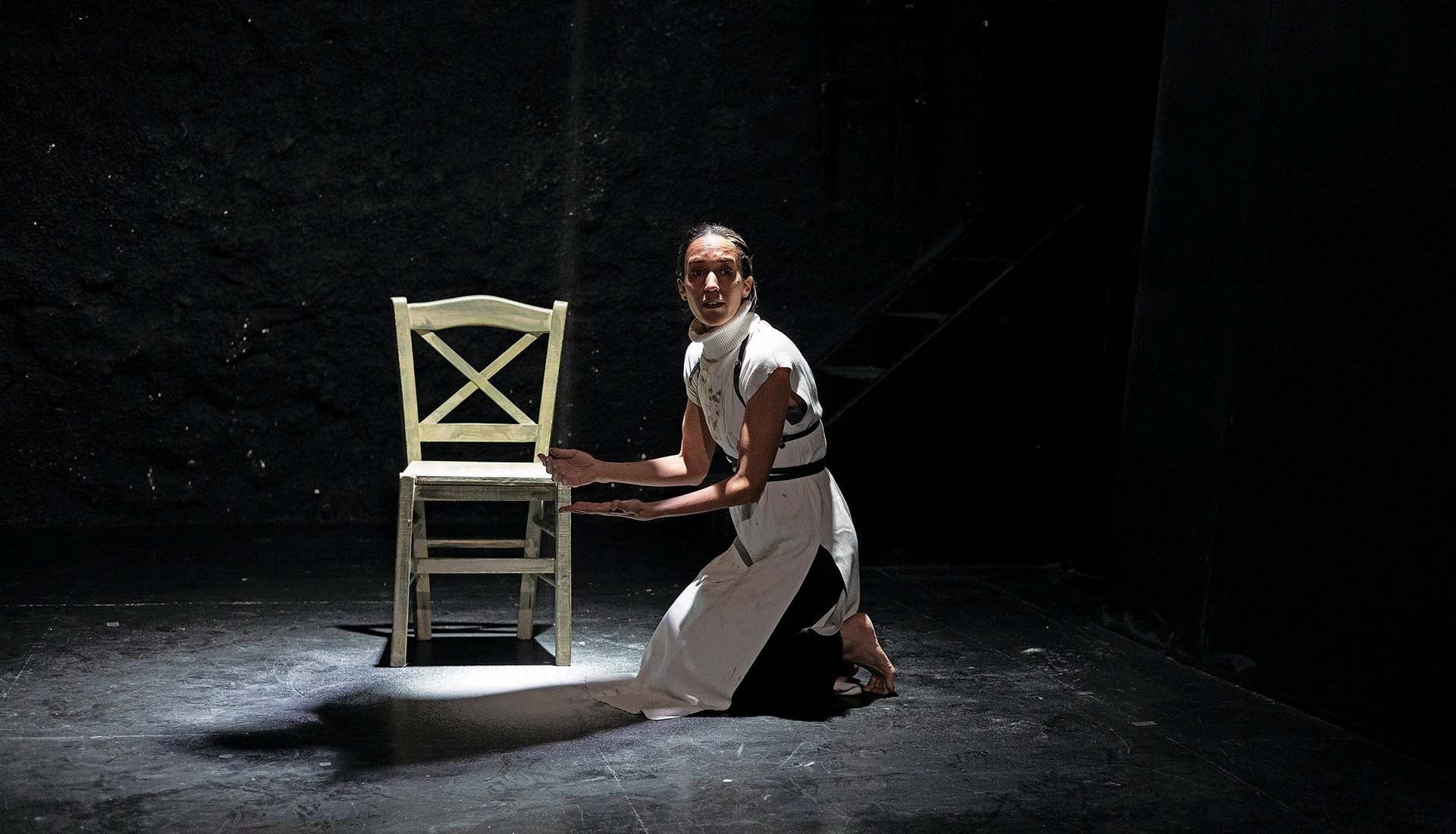
La Fréchette racconta nella postfazione all’edizione francese che è stata propria la lettura del saggio della Honig ad averla in un primo momento sbalordita e scioccata per poi imporsi nella sua mente con una fascinazione irresistibile. La riscrittura di questo momento ‘mai raccontato’ della tragedia di Sofocle si realizza nella pièce attraverso una intensa rievocazione di Ismene. In un primo momento l’agitazione, il camminare frenetico nella sua stanza, i dubbi, il batticuore, la paura che Antigone venisse scoperta; poi la decisione di uscire, salire sulla collina dove Polinice è stato abbandonato insepolto per provare almeno a fermare la sorella; e, alla fine, il momento in cui trovatasi tutta sola al cospetto del corpo del fratello Ismene decide di agire e compie lei il gesto di ricoprirlo soltanto con qualche pugno di terra. La protagonista confessa le motivazioni agli spettatori: prevenire l’azione che sarebbe stata sicuramente plateale da parte di Antigone; vincere d’astuzia Creonte; e soprattutto tentare e sperare che la catena dell’odio finalmente si arresti.
Tornata in stanza, Ismene rivive il momento di euforia che l’ha presa, la felicità per aver saputo trovare la forza di agire, di fare anche lei qualcosa: balla quasi ubriaca. Subito dopo però ripiomba nello sconforto quando immagina di correre da Antigone per annunciarle il suo gesto: si immagina infatti che la sorella lo avrebbe liquidato come ‘pauroso’, insufficiente, indegno di un vero rito di sepoltura accompagnato da libagioni rituali. L’intera scena è una delle più emozionanti del dramma, per la notevole capacità di introspezione psicologica da parte della drammaturga nel ricreare gli stati d’animo contradditori di Ismene e da parte dell’attrice protagonista nel materializzarli in scena: una combinazione di esaltazione, coraggio, senso di colpa e paura, e soprattutto un misto tra egoismo (l’orgoglio per aver trovato il coraggio di disobbedire e la soddisfazione del proprio amor proprio nel poterlo finalmente rivelare) e di generosità (il tentativo e la speranza di salvare la sorella amata).
L’episodio finale che Ismene racconta nel monologo corrisponde alla seconda e ultima scena in cui appare nel dramma antico – l’interrogatorio di Creonte ad Antigone, nella seconda parte del quale anche lei è presente – ancora una volta amplificato attraverso il vissuto interiore della protagonista e il non detto rivitalizzato del testo sofocleo. All’annuncio delle guardie che Antigone è stata colta in fragrante e catturata, Ismene racconta di essere crollata ‘infinitamente’ al suolo svenuta: la sua azione non è servita a niente. Creonte ha fatto portare entrambe le sorelle al suo cospetto e pensa che anche Ismene sia stata complice nella sepoltura di Polinice. Lei conferma di aver partecipato, ma Antigone nega con sdegno in versi famosi (Ant. 543ss.): «Non amo chi ama solo a parole... non arrogarti cose che non hai fatto... basta la mia morte». Ismene nel ricordare queste parole – che la sorella nei suoi ricordi pronuncia con un riso beffardo – confessa al pubblico che erano state come delle frecce, degli schiaffi. Aggiunge che per Antigone non c’è posto per quel ‘noi’, simbolo di condivisione che lei tanto sperava di poter ritrovare dopo il dissidio iniziale per aver di fatto davvero contribuito alla sepoltura del fratello, compiendo il primo rito funebre anche se in maniera parziale e simbolica. Racconta però anche un ultimo fondamentale dettaglio. Nel momento in cui le guardie su ordine di Creonte afferrano lei e la sorella – destinata ora a morte certa – per rinchiuderle nel palazzo:
I nostri corpi si sfiorano. I nostri sguardi si incrociano.
In un lampo credo di vedere
un velo sollevarsi dagli occhi di Antigone.
Una dolcezza, mi sembra, un barlume di tenerezza.
Come se stesse pensando: ‘sorella mia’,
‘Ismene sorella mia’
Nella conclusione del dramma Ismene medita su questo ultimo sguardo di dolcezza, si domanda se Antigone – che nel frattempo dopo essere stata rinchiusa in una caverna è morta impiccatasi – non abbia voluto salvarla prendendosi tutta la colpa: se dietro il cinismo e la gelida asprezza non si nascondesse in realtà l’amore. Da qui la meditazione si allarga sul significato dell’eroismo. L’eroina ‘mite’ si chiede dapprima se il sacrificio di Antigone non fosse in effetti inevitabile, se non fosse cioè necessario un gesto di resistenza e di coraggio plateale perché il popolo capisse che è possibile andare contro il potere costituito. Ismene si dice fiera della sorella, l’ammira e la comprende. Eppure, si fa un’altra domanda subito dopo, chiedendosi se davvero un sacrificio del genere sia indispensabile, se davvero l’unica soluzione praticabile sia quella inesorabile dell’intransigenza con il rischio distruttivo e autodistruttivo che comporta. Il dubbio è non solo lecito, ma fondamentale. E la risposta conclusiva della drammaturga francese è che in fondo ciascuno ha il suo ruolo nel teatro del mondo, e che forse c’è sì bisogno della grandezza eroica di una Antigone, ma anche e di più della forza del dubbio, dell’incertezza e soprattutto di un’altra ostinazione, meno clamorosa della ribellione, che è la volontà di preservare ciò che è vivo, di scegliere la vita e non la morte, e di mettere fine una volta per sempre alla catena dell’odio e della guerra. E in una conclusione opposta a quella grandiosa ma tragica e mortifera dell’Antigone di Sofocle, questa Ismene termina senza clamore, ma con una domanda colloquiale, semplice e diretta, che è un invito finale alla riflessione e al dialogo:
Tutta questa luce che mi acceca, mi riscalda anche.
Non ho più niente da raccontare.
Ma, se per voi va bene, vorrei restare ancora un po’.
Forse avete delle domande?
Ismene resterebbe infatti senz’altro ad ascoltare – viene da pensare – lei che ha chiesto di essere ascoltata e si è battuta perché l’attenzione e l’ascolto altrui non vengano mai meno.
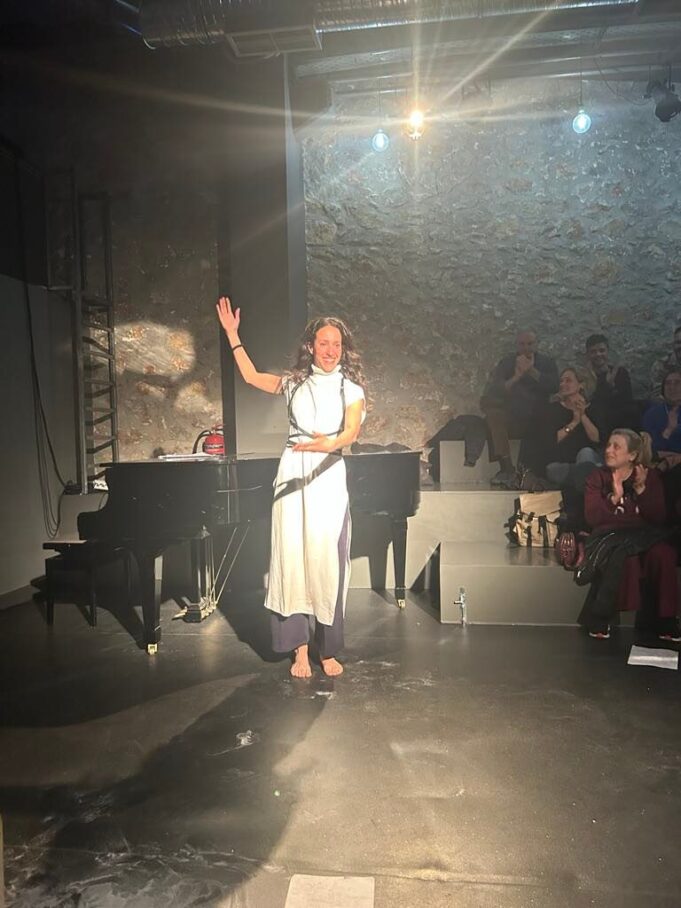
L’ invito è stato in effetti felicemente accolto alla fine dello spettacolo cui abbiamo assistito al teatro Arroyo di Atene. Alla rappresentazione è seguito infatti un incontro di discussione comune tra gli spettatori presenti, l’attrice protagonista e alcune docenti di teatro all’università di Atene durato quasi quaranta minuti. Si è trattato di un momento civico importante in cui sono emersi commenti sulla scenografia, sul testo, e soprattutto su Ismene e sul suo appello alla difesa della vita: ζωή (‘vita’) è stata la parola che più di tutte è risuonata durante il dibattito. Più di uno spettatore si è detto conquistato da questa nuova Ismene così diversa e ricca rispetto alla figura della sorella minore ignava e scialba che di solito viene portata in scena nelle rappresentazioni dell’Antigone. Ci piace però ricordare un momento finale del dibattito in cui l’attrice Elettra Fragkiadaki ha fatto una riflessione più generale sul teatro e sulla letteratura richiamandosi al primo verso dell’ultima citazione riportata dalla chiusa del monologo: la ‘luce del palcoscenico’ è ciò che permette di riscaldare i cuori anche in momenti molti bui, attraverso il racconto di storie commoventi. In effetti sembra proprio questo il messaggio dell’Ismene della Fréchette, di meditazione ma anche di speranza.
Come si è visto sono molti gli spunti di urgente riflessione rispetto alla frenesia bellica autodistruttiva dominante del nostro tempo che risuonano nei dubbi e nelle domande del monologo: la salvaguardia della vita e del futuro del vivente; il rifiuto della violenza; se valga davvero la pena morire per un principio astratto o se invece la vera ribellione e la vera resistenza non consistano nel cercare di convivere insieme; che cosa siano davvero il coraggio e l’eroismo: morire o sopravvivere?
D’altro canto, queste interrogazioni aprono a una prospettiva di fiducia meno pessimistica rispetto alle ‘Ismeni’ precedenti, a partire da quella di Ritsos, fino a quelle citate all’inizio di Lot Vekemans e Colm Tóibín. Anche in queste riscritture si denuncia il pericolo dell’eroismo intransigente di Antigone e si sposa l’ideale antieroico del buon senso tollerante e pacato di Ismene ma l’atmosfera di fondo resta tuttavia per lo più cupa e avvolta in un sentimento di torpore e di impotenza, senza slanci o comunque legata alla memoria e al passato. La forza vitale di questa Ismene, invece, sta proprio nella delicata, insicura, fragile ma appassionata fermezza di un appello positivo e costruttivo alla riconciliazione, alla pace e alla custodia della vita. È questa infatti «l’altra missione» di cui l’Ismene di Carole Fréchette si fa portavoce, lei che già nel nome reca inscritta l’importanza del ‘prestare attenzione’ ad ogni manifestazione del vivente, perché ‘ha visto’, ‘ha fatto attenzione’ e quindi ‘sa’, come indica l’etimologia più probabile del nome greco Ἰσμήνη da ricondurre al verbo greco οἶδα (‘ho visto’ quindi ‘so’, ‘conosco’)[12]. Sottratta dall’ombra in cui il fascino abbagliante di Antigone la relegava – fascino che Jacques Lacan definiva però un «fulgore insopportabile» proprio perché legato a un inquietante ‘desiderio di morte’[13] – Ismene invita al compito arduo ma fondamentale di avere attenzione e cura per la molteplicità dei punti di vista, di rispettare ogni istanza distinta e conflittuale, sforzandosi di armonizzarle per tentare di trovare un punto di accordo, magari attraverso un gesto discreto e simbolico che soddisfi, almeno parzialmente, le esigenze contrapposte, come avviene nel caso della prima sepoltura. Le armi di questa impervia impresa etico-politica sono quelle della sensibilità dell’ascolto della comunicazione e del dialogo, inverse ad ogni elemento di prepotenza – hybris – destinata a produrre l’esito deleterio della parabola tragica dei fanatismi di Creonte e di Antigone: è forse questa la vera ‘amicizia vitale e reciproca’ – philia e soprattutto symphilein (Ant. 523): da costruire insieme e in relazione – che l’invito finale e dialogante alla speranza di Ismene lascia agli spettatori.
E proprio un sentimento di speranza, in conclusione, risuona anche nelle musiche scelte per lo spettacolo dal regista greco Manolis Seiragakis, che è anche studioso di musica. Si tratta di due brani, uno classico e uno contemporaneo, di nuovo a simboleggiare il legame tra l’antico e il presente. Il primo è il secondo minuetto della prima Suite in Sol Maggiore per violoncello BWV 1007 di Bach, che ritorna a più riprese nel corso del monologo, soprattutto la frase musicale iniziale il cui carattere di pensosa compostezza richiama la sobrietà della protagonista. Il brano riprodotto è quello della registrazione del violoncellista greco Yorgios Kaloudis suonato su lira cretese e pubblicato nel CD J.S. Bach: Cello Suites on the Cretan Lyra dell’etichetta DNA: lo si può ascoltare qui. La seconda traccia musicale è la composizione The Fosse del compositore belga Wim Mertens, pubblicata nell’album Educes Me del 1987, una cui registrazione live molto bella si trova sul canale ufficiale YouTube dello stesso compositore (qui). Il brano, minimalista ma particolarmente melodico e poetico, risuona in apertura e alla fine dello spettacolo: la linea emozionante del canto affidata a un ensemble di voci femminili che richiama il coro della tragedia antica, pur se mai abbandonata da un fondo di struggente malinconia, sembra rispecchiare la protesta dolce di Ismene e la sua speranza di venire, forse questa volta, finalmente ascoltata.
Ismène / Ismene / ΙΣΜΗΝΗ
di Carole Fréchette
Teatro Arroyo, Atene
Traduzione: Dimitris Filias
Regia: Manolis Seiragakis
Scenografia-costumi: Kalli Karadaki
Foto: Efi Karanikola - Evangelos Exarchos - Kostas Giokas
Trucco: Eleni Zourelidou
Organizzazione e realizzazione della produzione: Teatro Antivaro
For Ismene: Carole Fréchette Gives Voice Back to Antigone’s Younger Sister: The Reasons of Life Against War
In the endless history of the reception of Sophocles’ Antigone, the figure of Ismene has not fared particularly well. She has usually been regarded as the negative counterpart of her sister Antigone – the indomitable, rebellious heroine who challenges the arrogance of power without the slightest hesitation and at the risk of her own life. Ismene, instead, has long symbolised the position of those who passively accept the status quo, to the point of being almost mocked for her fear. This has happened, for example, in the work of prominent female and feminist interpreters, who have sanctified Antigone as a forerunner of resistance to patriarchy and of women’s emancipation, while accusing the conformist sister of submitting to male and patriarchal power, personified by Creon.
A notable example is that of the great thinker of sexual difference, Luce Irigaray, who in her foundational book Speculum, of the Other Woman (published in French in 1974 and translated into Italian the following year, edited by Luisa Muraro) presents Ismene almost as a caricature – a stereotype of woman as submissive feminine imposed by the androcentric cultural tradition of the West: «Ismene appears incontestably as a woman, and this also because of her weakness, her fear, her compliant obedience, her tears, madness, hysteria»[1].
In recent years, however, several reinterpretations and rewritings of the tragedy have reassessed the seemingly secondary figure of the ‘gentle’ Ismene, to the point of completely overturning the traditional interpretation. At least two plays spring to mind: Zus van (“Sister of”, 2005) by the Dutch playwright Lot Vekemans, and Pale Sister (2019) by the Irish playwright Colm Tóibín. Ismene now returns to the spotlight in the recent and fascinating theatrical monologue by the award-winning Canadian playwright originally from Montreal, Carole Fréchette, significantly titled Ismene and first published in French in 2023[2].
The author, born in 1949, has a background as an actress and was active in Quebec’s feminist theatre scene of the 1970s, particularly within the Theatre des cuisines collective, appearing in plays that championed women’s rights, such as Nous aurons les enfants que nous voulons, which addressed the right to abortion. From the second half of the 1980s, she turned to playwriting, and since then has continued to write plays, publishing more than twenty and winning numerous awards, including the Siminovitch Prize (2002), Canada’s most prestigious literary award, and the Governor General’s Literary Award twice (1995, Les Quatre morts de Marie; 2014, Small Talk). She was also a finalist for the prestigious Grand Prix de Littérature dramatique in 2009 and 2022.
Most of her works feature female protagonists, often positioned on the margins of society, to whom Carole Fréchette restores a voice, as is precisely the case with Ismene. She is also the author of three novels for young adults, one of which has been translated into Italian by Luca Scarlini: Do come Dolores (Milan, Buena Vista, 2006), the story of a friendship between two girls that turns into an intriguing mystery. The vast majority of her plays have been translated into numerous languages and staged in several countries around the world, including Canada, the United States, France, Germany, Belgium, England, Spain, Portugal, Greece, Iceland, Israel, Japan. Unfortunately, the author has so far received very little attention in Italy where her work deserves to be more widely translated and staged.
The Fréchette Ismene we attended was staged in Athens from March 7 for approximately one month, running every Saturday and Sunday at the Arroyo Theatre, in a production directed by theatre director and theatre studies lecturer Manolis Seiragakis. The Modern Greek version of the play was translated by the French scholar Dimitris Filias and published by Liotrivi–Panagiota G. Sarafi[3]. This marked the Athenian debut, following the premiere on 19 November 2024, at the International Book Festival of Tripoli in the Peloponnese, where the monologue had been staged by the Cretan theatre company Antivaro from Rethymno, co-founded by Seiragakis himself.
Ismene appears alone on stage, portrayed by the young emerging Greek actress Elettra Fragkiadaki, in a truly beutiful performance that is both intense and delicate. The stage design is sparse and minimalist, reflecting the protagonist’s restrained yet determined nature: indeed every physical and verbal gesture by Ismene, though discreet, acquires essential weight in the Canadian playwright’s reworking of the myth. Dressed in a simple sleeveless Doric chiton, Ismene is accompanied only by a chair, a small table with a glass of water, and sheets of paper on which she has jotted down notes for her personal presentation of the ancient and infamous events of the myth. This presentation has been commissioned by an unspecified group of people who claim to be fascinated by her story and believe that Antigone’s sister «has not received all the attention she deserves». The only other object on stage is an ochre-coloured sack filled with dust, suspended above the chair, from which white powder is released: a symbol of Polynices’ burial, but also of the death Antigone will bring upon herself by hanging from a noose in the cave. The rather small stage divides the theatre hall in two, with the audience seated on steps very close to the stage on both sides.
Ismene addresses the audience with a down-to-earth ‘Good evening’, which sets from the very first line the tone of the entire monologue. Written in a straightforward and direct style, it unfolds almost like an intimate self-confession by the character, yet it is by no means monotonous; on the contrary, it is rich in emotional nuance, ranging from sadness to anger, from uncertainty to protest, and from despair to hope.
The Canadian playwright thus gives voice back to a character to whom Sophocles had assigned only a few lines in the tragedy: Ismene is finally granted the time and space to relive and recount, from her own perspective, all the well-known events not only of Sophocles’ Antigone but also of the saga of the Labdacids – that is, the cursed family of Oedipus, son-husband of Jocasta, and their children: the two brothers Eteocles and Polynices, and the two sisters Antigone and Ismene.
The conversational tone brings the protagonist closer to the audience: she appears at once as a figure from ancient myth and as a contemporary woman. Full of doubts and uncertainties, Ismene stands alone on stage: a space entirely her own, where she can be heard and taken seriously, and from which she claims her reasons – which, as we shall see, are those of a young woman who has chosen life and the end of the cycle of vengeance in the face of death and war. There is no need to emphasize the strong relevance of this theme in light of the tragic and sad events of our time.
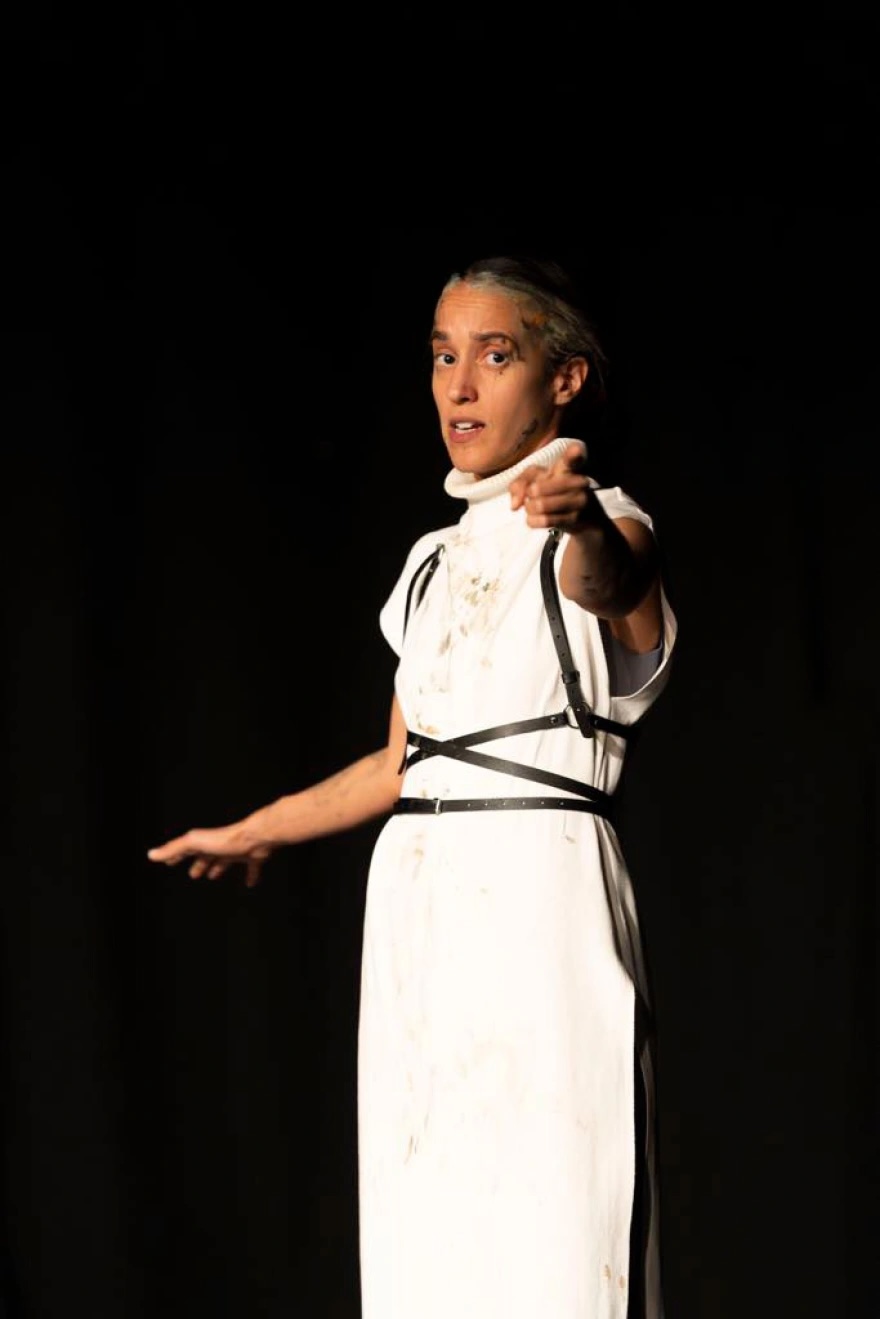
The opening lines of the monologue are provocative and telling: Ismene explains that she had been asked to provide a title for her talk but decided not to. She has instead asked the people who invited her to speak to come up with a title themselves because ‘she trusts them’:
That’s just the way I am.
I trust.
Authorities, those in charge, the experts.
Some call it submission.
I say: I trust.
It’s my default position.
Is that the right way to put it?
By default, I trust
The age-old accusation of subservience and cowardice levelled at Antigone’s younger sister – aptly summed up by the poet Stefano Raimondi as ‘«la violenza del silenzio, dell’inazione»[4] – is thus immediately called into question by the Canadian playwright. Having established the fundamental importance of mutual trust in human interactions, Ismene then asserts her autonomy. She recounts that at the start of her notes, to introduce herself, she had written the phrases «I am the daughter of», «I am the sister of», but that she later erased them them and replaced them with «I am Greek», claiming a fresh start to her own story, no longer dependent on her family members who are far more famous in the mythical saga, as she is quick to remind the audience: her father Oedipus, who gouged out his eyes upon learning he had married his mother; her mother Jocasta, who hanged herself after the same discovery; her two brothers, who died in a fratricidal war; and, of course, Antigone
Everyone knows her name.
You’re already looking at me differently.
You’re thinking: ah, she’s the sister of… she’s the daughter of…
The first mythical episode that Ismene recalls in her monologue is the struggle for the rule of Thebes between her two brothers, which led to Polynices’ military attack against Eteocles and the death of both, each at the other’s hands. This is a flashback to the event that form the premise of Antigone, but to which Sophocles makes only sparse, albeit significant, references in the ancient play. Thus, before the audience stand Ismene’s attempts at reconciliation and her urgent, pleading entreaties to her two brothers:
I ran from one to the other.
I said: listen to each other. You have to talk.
I cannot choose between the two of you.
You are my brothers.
I want you to make peace. Both of you.
Here and in all subsequent dialogues, the double voices and the physical confrontation between pairs of characters are brought to life on stage by the actress through verbal intonation and through a clear, sharply defined gestural language, especially the oscillation of arms and hands, charged with eloquent essentiality (as can also be seen in the production’s trailer).
However, Ismene appears naïve to Eteocles and Polynices, incapable of understanding the logic of power, which demands partisan choices that in turn lead inevitably to conflict, even in forms of extreme violence. The protagonist dwells in particular on the description of the horrific details that war entails, using a series of graphic images introduced by a precise and powerful metatheatrical reference by the playwright to the recent spiral of tension and bellicose frenzy:
War has broken out.
We say, ‘War has broken out,’ and then we carry on telling the story,
as if it were a detail. As if we were saying:
a storm broke out and then the weather cleared up again.
I say: war has broken out, and I pause.
I don’t know what that word means to you today.
Back then, for human beings, it meant...
At this point, a moment of the playwright’s inventive symbolic inspiration emerges, drawing on a typical feature of ancient Greek culture often present in tragedies: the prayer to a divinity in a temple or at an altar. We thus learn that Ismene, in those tense days of alarm as civil war loomed, had rushed to the small temple of Eirene, ‘Peace’, where the face of the goddess’ statue – holding a child in her arms – appeared «full of sweetness». We also learn that Antigone’s preferred goddess, instead, was Athena, patroness of wisdom and reason, but also of «just war».
After Ismene’s unanswered prayers comes the brief yet intense account of the fratricidal clash, but before that the protagonist’s melancholic resignation gives voice to a series of questions that resonate as some of the most powerful and significant in the play:
Who wants peace? Truly?
Who is willing to make sacrifices on the altar of Eirene?
Who is willing to lose something to preserve harmony?
To lose power, territory, possessions, to lose honor?
Losing is a disgrace, isn’t it?
And where do we draw the line between compromise and cowardice?
As will become clearer shortly, it is evident that the Canadian playwright endorses the view of those who have interpreted Ismene’s attempts at mediation in Antigone in a positive light, recreating another such example in the episode that precedes Sophocles’ drama: the internecine conflict between Eteocles and Polynices.
The invitation is to try to find common ground, to seek dialogue and the middle path of compromise, and to avoid irreconcilable positions born of stubborn and sterile pride, blinded in this case by the thirst for power. This would certainly be a precarious and imperfect solution, but one that is pragmatically effective in preventing the potentially destructive and self-destructive force of violence, if it were to be practiced.
Ismene continues her narrative uninterrupted, in which emotional nuances remain the central focus, and where the actress performs at her best through shifts in intonation, sudden changes in vocal volume, and simple yet powerful movements within the narrow but focused stage space between the two tiers of the audience. She sadly confesses that the sight of the lifeless, intertwined bodies of Eteocles and Polynices – a monstrous creature with two heads, four legs, and four arms – and the grief that overwhelmed her have also deprived her of tears and of the ability to feel love for her two brothers.
At this point, the sequences retracing the plot of Sophocles’ Antigone begin. The first scene is the famous opening dialogue between the two sisters. Carole Fréchette’s interesting approach is to follow the Sophoclean text, translating passages literally, but expanding them through the protagonist’s memories and reflections: a metatext is thus created, in which the author can engage in dialogue with the ancient poet, comment on him, and further develop the implications left unspoken in the original. A significant example is found in lines 31-32, where Antigone informs her sister of Creon’s decree ordering that Polynices, the traitorous brother who attacked Thebes, be left unburied:
And Antigone said to me, «This ban applies to everyone. To you as much as to me!»
And she added, «To me as well».
I remember that «To me as well », which she almost shouted.
As if she could not believe that Creon would inflict such an affront upon her: upon her, upon Antigone.
As if everything were merely a personal matter between her and him.
The subsequent exchange between the two sisters marks one of the play’s key moments, in which Ismene clearly articulates her worldview, and through which the Canadian playwright conveys a powerful ethical and political message.
The character is torn by a mixture of love and hatred for Antigone, with whom she shares principles on a general level, but not their practical enactment when this entails harmful consequences both for individuals and for the common good. On stage, the protagonist vividly relives the accusation that she refuses to help bury Polynices out of fear, as Antigone harshly and violently reproaches her.
She feels wounded and excluded, yet does not yield; instead, she asserts her reasons, protests, and in turn accuses her sister through a series of pressing questions, delivered by the actress almost in a shout, with great vehemence:
You don’t listen to me, you never listen to me.
Because you KNOW. You know what’s right. But how…
How can you assert with such absolute certainty that the laws of the gods
are more important than anything else?
How can you not wonder, not even for a fraction of a second, whether we shouldn’t establish
some rules so we can live together?
How can you have not even a doubt, not put yourself in the shoes of those who must govern,
not even try to engage in discussion?
Where does this absolute certainty come from?
The moment of greatest intensity, however, comes immediately afterwards, when Carole Fréchette has her minor heroine respond to what has always been the most serious accusation levelled against her: that she justifies fear and her inability to act by virtue of being a woman, and as such incapable of fighting against a man and his decrees (cf. Ant. 61-62: «we must also consider that we were born women / that we do not have the strength to fight against men»):
All I wanted to say is:
perhaps we are entrusted with another mission:
that of perpetuating life, of preserving what is alive.
Is it so terrible to think such a thing?
If we do not preserve life, who will? Certainly not our brothers.
I’ve had enough of your ‘either-or’ arguments; ‘either you agree with me or you’re a coward’.
This suffocates me. You suffocates me, Antigone!
Ismene, on the one hand, claims the reasons of practical wisdom: doubt, compromise, dialogue, identification with the other, and the acceptance of life in its imperfections, without demanding at all costs that things conform perfectly to one’s ideals. On the other hand – and this is the greatest novelty in this Ismene – the true underlying motivation, the real dividing line, lies between those who choose in favour of life and the living, that is, the well-being and future of a peaceful shared existence, and those who instead sacrifice everything, even living and beloved persons, in the name of an abstract principle of justice to defend the rights of a dead person.
These are the famous ‘unwritten laws’ of which Antigone is the unwavering champion, yet they are also the laws of Hades, god of the dead, and which compel the protagonist of Sophocles’ tragedy to be bound more to death and to ‘her’ dead – those of her incestuous family – than to life and to other living people, first and foremost her own sister and her fiancé Haemon.
The theme of practical wisdom as an antidote to the dogmatic and ruinous absolutism of both Antigone and Creon, which underlies Sophocles’ Antigone, has in fact already been supported in the past by several distinguished thinkers, including the great French philosopher Paul Ricœur, the American philosopher Martha Nussbaum, and in Italy the jurist and former president of the Constitutional Court Gustavo Zagrebelsky[5]. The emphasis on the theme of the defence of life, at least in terms of theatrical reception, is instead certainly original.
The importance of the theme of life in opposition to death is already evident in the production’s poster image, which also appears as the cover of the Greek translation of the text. It shows a bust of the actress, naked and seen in profile, her skin covered in a brownish-green and greyish clay-like material – the colours of the earth – and wrapped in branches from a tree, a clear symbol of nature’s fertility and the generation of life. However, this is not the first time that Ismene’s figure has been interpreted in this way. The contemporary philosopher Mary C. Rawlinson, a representative of critical theory and feminist thought, had already offered a similar interpretation to that of the Canadian playwright. In an essay published in 2014[6] and later republished as a chapter in the book Just Life (2016), she strongly defended Ismene’s ‘pro-life’ arguments. Although Fréchette does not appear to be familiar with her work, Rawlinson’s philosophical reading seems to clarify in the most effective way the very meaning of this recent Ismene, and it is therefore worth quoting a few passages from the philosopher:
«Of all the calumnies and condemnations heaped upon Ismene’s head, only one is true: like Hegel’s slave, she remains attached to life. Only Ismene shows the fluidity and generosity of spirit that refuses to sacrifice relations with real humanbodies to abstract principles or the pride of authority. She never loses her temper with anyone. She is reticent instead of impatient, conciliatory instead of rigid. She is the only one not guilty of sticking fast with heart and head to a rash and intemperate decree. Most important, instead of sticking to the past and the dead, she repeatedly invokes the future. The absolute value for her is living on with those she loves: “What would my life be without you?” Prudent, clever,courageous, absolutely constant, and generous of spirit, Ismene lives on among the living dead who have sacrificed themselves and their sons and daughters to the pride of an abstract principle. Preferring reconciliation to revenge, life to honor, she exhibits the mobility of thought and feeling that makes forgiveness possible»[7].
As can be seen, the emphasis falls on responsibility for the future and the preservation of life. Both are made possible primarily through the practice of care, both in relation to interpersonal relationships and to the future good of the collective political community.
It should also be noted that another fundamental element which the philosopher sees symbolised in Ismene’s ethical stance is that of reconciliation and forgiveness – that is, the capacity to overcome, in a positive and constructive way, the conflicts that are often inevitable in human life, avoiding becoming entrenched in positions of stubborn and deaf inflexibility, as both Creon and Antigone do[8]. In this sense, two terms repeatedly used by the author in relation to the two protagonists of the drama are particularly significant – hardheadedness and hardheartedness – which very aptly express the ‘hardness’ of mind and heart that unites them.
Another key scene in the performance is the account of Polynices’ first burial. The Canadian playwright adopts a strongly minority variant in interpretations of Antigone and makes Ismene the author of this initial funerary rite, which in Sophocles’ original already presents highly unusual features.
As the sentry reports to Creon (Ant. 253-58), someone – unseen, during the night, and leaving no trace on the ground – has not exactly buried the corpse, but merely sprinkled it with a thin layer of dust. The enigmatic and mysterious atmosphere surrounding this first burial even leads the Chorus to believe that it may have been favoured, if not directly willed, by the gods (Ant. 278-79).
Recently, the political theorist Bonnie Honig has revived the hypothesis that the author of this first partial and sober funerary rite for Polynices was Ismene rather than Antigone[9]. Indeed, compared to the second burial that Antigone performs in broad daylight, screaming at the sight of Polynices’ unburied body and without the slightest concern for going unnoticed, this first gesture – nocturnal and almost furtive – seems very much in Ismene’s style. In the prologue, in fact, Ismene had advised her sister to act «in secret, without telling anyone» (Ant. 84-85), if she truly intended to defy Creon’s decree: in order to honour her brother with funeral rites without being discovered and therefore sentenced to death. Antigone, however, had responded with her usual scornful pride: «No, rather proclaim it aloud: you will be even more hateful to me / if you stay silent and do not announce it to everyone» (Ant. 86-87).
Fréchette recounts in the afterword to the French edition that it was precisely her reading of Honig’s essay that initially astonished and shocked her, before gradually taking hold of her imagination with an irresistible fascination. The rewriting of this ‘never-told’ moment in Sophocles’ tragedy is realised in the play through an intense evocation by Ismene. At first, the agitation, the frantic pacing in her room, the doubts, the pounding heart, the fear that Antigone might be discovered; then the decision to go out, to climb the hill where Polynices has been left unburied to at least try to stop her sister; and, finally, the moment when, finding herself all alone before her brother’s body, Ismene decides to act and performs the gesture of covering him with just a few handfuls of earth.
The protagonist confesses her motivations to the audience: to pre-empt Antigone’s inevitably spectacular act; to outwit Creon; and above all to try and hope that the chain of hatred might finally be brought to an end.
Back in her room, Ismene relives the moment of exhilaration that overtakes her, the joy of having found the strength to act, of having done something herself: she almost dances, intoxicated. Immediately afterwards, however, she sinks back into despair when she imagines running to Antigone to announce what she has done – only to picture her sister dismissing it as ‘fearful’, insufficient, unworthy of a true burial rite accompanied by ritual libations.
The entire scene is one of the most moving in the play, for the playwright’s remarkable capacity for psychological introspection in recreating Ismene’s contradictory states of mind, and for the lead actress’s ability to ability to bring them to life on stage: a combination of exhilaration, courage, guilt, and fear, and above all a tension between selfishness (the pride in having found the courage to disobey and the satisfaction of self-esteem in being able to reveal it) and generosity (the attempt and hope to save her beloved sister).
The final episode that Ismene recounts in the monologue corresponds to the second and last scene in which she appears in the ancient drama – Creon’s interrogation of Antigone, during the latter part of which she is also present – once again amplified through the protagonist’s inner experience and the revitalised ‘unsaid’ of the Sophoclean text.
Upon the announcement by the guards that Antigone has been caught in the act and arrested, Ismene recounts collapsing ‘infinitely’ to the ground, fainting: her action has served no purpose. Creon has both sisters brought before him and believes that Ismene, too, has been complicit in Polynices’ burial. She confirms her participation, but Antigone denies it with contempt in some famous lines (Ant. 543ff.): «I do not love those who love only in words… do not claim deeds you have not done… my death is enough»
In recalling these words – spoken by her sister with a mocking laugh in her memory– Ismene confesses to the audience that they were like arrows, like slaps. She adds that for Antigone there is no place for that ‘we’, the symbol of shared belonging, which she had so deeply hoped to recover after their initial conflict, having in fact truly contributed to her brother’s burial by performing the first funerary rite, albeit in a partial and symbolic form.
She does, however, also recounts one final crucial detail. At the moment when the guards, on Creon’s orders, seize her and her sister – now destined for certain death – to imprison them in the palace:
Our bodies brush against each another. Our gazes meet.
In a flash, I think I see
a veil lifting from Antigone’s eyes.
A sweetness, it seems to me, a glimmer of tenderness.
As if she were thinking: ‘my sister’,
‘Ismene, my sister’
In the conclusion of the play, Ismene reflects on this final gaze of tenderness, wondering whether Antigone – who in the meantime, after being confined in a cave, has died by hanging herself – may have wanted to save her by taking all the blame upon herself: whether behind her cynicism and icy harshness there was in fact love. From here, her meditation expands into a broader reflection on the meaning of heroism. The ‘gentle’ heroine first asks herself whether Antigone’s sacrifice was in fact inevitable, whether a gesture of resistance and blatant courage was necessary in order for the people to understand that it is possible to stand against established power. Ismene feels proud of her sister, admires her, and understands her.
And yet she immediately asks another question, wondering whether such a sacrifice is truly indispensable, whether the only viable solution is indeed that of relentless intransigence, with all the destructive and self-destructive risks it entails. The doubt is not only legitimate, but essential.
And the playwright’s final answer is that, that, ultimately, everyone has their role in the theatre of the world, and that perhaps there is indeed a need for the heroic grandeur of an Antigone, but also – and even more so – for the power of doubt, uncertainty, and above all for another kind of obstinacy, less sensational than rebellion: the will to preserve what is alive, to choose life rather than death, and to put an end once and for all to the chain of hatred and war.
And in a conclusion that stands in contrast to the grandiose yet tragic one of Sophocles’ Antigone, this Ismene ends without fanfare, but with a conversational, simple and direct question, which is a final invitation to reflection and dialogue:
All this light that blinds me also warms me.
I have nothing left to tell.
But, if it is ok with you, I would like to stay a little longer.
Perhaps you have some questions?
One might well imagine that Ismene would certainly stay to listen – having asked to be heard and having fought to ensure that others’ attention and willingness to listen never fail.
The invitation was indeed recieved at the end of the performance we attended at the Arroyo Theatre in Athens. The performance was followed by a public discussion involving the spectators present, the lead actress, and some lecturers in theatre studies from the University of Athens, lasting nearly forty minutes. It was a significant civic moment in which comments emerged on the scenography, the text, and above all on Ismene and her appeal for the defence of life: ζωή (‘life’) was the word that resonated most strongly throughout the discussion.
More than one spectator expressed being captivated by this new Ismene, so different and richer than the figure of the indolent and colourless younger sister usually portrayed in productions of Antigone. We would like to recall a final moment in the debate when the actress Elettra Fragkiadaki offered a more general reflection on theatre and literature, referring back to the first line of the final quotation from the monologue’s closing: the ‘light of the stage’ is what allows hearts to be warmed even in the darkest times, through the telling of moving stories. Indeed, this seems to be the message of Fréchette’s Ismene: one of reflection, but also of hope.
As we have seen, there are many points for urgent reflection regarding the self-destructive frenzy of war that dominates our times which resonate in the doubts and questions raised in the monologue: the preservation of life and the future of living beings; the rejection of violence; whether it is truly worth dying for an abstract principle, or whether true rebellion and true resistance consists instead in seeking to live together; what courage and heroism truly are: dying or to surviving? On the other hand, these questions open up a more optimistic outlook than that found in other previous ‘Ismenes’, from Ritsos’s version to those mentioned at the beginning by Lot Vekemans and Colm Tóibín. In these rewritings too, the danger of Antigone’s uncompromising heroism is denounced and the anti-heroic ideal of Ismene’s tolerant and calm common sense is embraced, yet the overall atmosphere remains mostly bleak, marked by a sense of torpor and powerlessness, without real momentum or, at any rate, tied to memory and the past. The vital force of this Ismene, instead, lies precisely in the delicate, insecure, fragile yet passionate firmeness of a positive and constructive appeal to reconciliation, peace and the preservation of life. This is, in fact, «the other mission» for which Carole Fréchette’s Ismene acts as a spokesperson; she who already carries in her name the importance of ‘paying attention’ to every manifestation of life, because she has ‘seen’, ‘paid attention’, and therefore ‘knows’, as suggested by the most likely etymology of the Greek name Ἰσμήνη, which can be traced back to the verb οἶδα (‘I have seen’, hence ‘I know’, ‘I am aware’)[10].
Rescued from the shadow into which Antigone’s dazzling charm relegated her – a charm which Jacques Lacan nevertheless described as a «unbearable splendor»[11], precisely because it is bound to a disturbing ‘death drive’ – Ismene invites us to undertake the difficult but essential task of attending to and caring for the multiplicity of viewpoints, respecting each distinct and conflicting claim, and striving to harmonise them in an attempt to find common ground, perhaps through a discreet and symbolic gesture that partially satisfies opposing demands, as in the case of the first burial.
The instruments of this difficult ethico-political endeavour are those of sensitivity, listening, communication, and dialogue, opposed to any form of overbearing force – hybris – destined to produce the deleterious outcome of the tragic trajectory of Creon’s and Antigone’s fanaticisms. Perhaps this is the true ‘vital and reciprocal friendship’ – philia and above all symphilein (Ant. 523) – to be built together and relationally, which Ismene’s final, dialogical invitation to hope leaves to the audience.
And it is precisely a sense of hope that, in conclusion, also resonates through the music chosen for the production by the Greek director Manolis Seiragakis, who is also a music scholar. Two pieces were selected – one classical and one contemporary – once again symbolising the connection between antiquity and the present.
The first is the second minuet from Bach’s First Suite in G Major for Cello BWV 1007, which recurs several times throughout the monologue, especially its opening musical phrase, whose thoughtful composure echoes the protagonist’s sobriety. The recording used in the production is that of the Greek cellist Yorgios Kaloudis, performed on the Cretan lyra and released on the album J.S. Bach: Cello Suites on the Cretan Lyra by the DNA label: the recording can be listened to here.
The second musical piece is The Fosse by the Belgian composer Wim Mertens, originally released on the 1987 album Educes Me. A particularly beautiful live recording can be found on the composer’s official YouTube channel (here). This minimalist yet highly melodic and poetic composition is heard both at the beginning and at the end of the performance: the moving vocal line entrusted to an ensemble of female voices – which evokes the chorus of ancient tragedy – though never detached from an undertone of poignant melancholy, seems to reflect Ismene’s gentle protest and her hope of being, perhaps this time, finally heard.
Ismène / Ismene / ΙΣΜΗΝΗ
by Carole Fréchette
Arroyo Theatre, Athens
Translated by Dimitris Filias
Directed by Manolis Seiragakis
Set and Costume Design by Kalli Karadaki
Photography by Efi Karanikola, Evangelos Exarchos, and Kostas Giokas
Make-up by Eleni Zourelidou
Produced by Antivaro Theatre
[1] Luce Irigaray, Speculum of the Other Woman, Ithaca, NY, 1985, pp. 217-18.
[2] Carole Fréchette, Ismène, Leméac, Montreal 2023: the translations from the original French, as well as those of the passages quoted from Sophocles’ Antigone, are our own. The show’s premiere took place that same year in France at the Théâtre de la Remise in Montpellier, directed by Marion Coutarel and starring the actress Mama Prassinos in the lead role: the programme is available here.
[3] Καρόλ Φρεσέτ, Ισμήνη. Δραματουργικός Μονόλογος. Λιοτρίβι-Παναγιώτα Γ. Σαράφη, Αθήνα 2024.
[4] Stefano Raimondi, L’Antigone. Recitativo per voce sola, Milano 2023, p. 60.
[5] Cf. Martha Nussbaum, The Fragility of Goodness: Luck and Ethics in Greek Tragedy and Philosophy, Cambridge 1986, Paul Ricœur, Oneself as Another, Chicago, London 1992 (or. ed. 1990), chapter 9; Gustavo Zagrebelsky, Il diritto di Antigone e la legge di Creonte, in La legge sovrana. Nomos basileus, edited by Ivano Dionigi, Milan, 2006, pp. 19-51. It should nevertheless be noted that in these texts reference is made primarily to the other minor characters in the drama – Haemon, Tiresias, and the Chorus – as representatives of an ethics of dialogue and practical wisdom. However, G. Zagrebelsky has on several public occasions expressed views in favour of Ismene, who in fact well embodies the virtue of doubt, to which the jurist dedicated his book La virtù del dubbio. Intervista su etica e diritto (Milano, 2007). In the rewritings of Ismene by Ritsos, Vekemans, and Tóibín mentioned above, it is instead Ismene herself who comes to personify practical wisdom.
[6] Mary C. Rawlinson, Beyond Antigone: Ismene, Gender, and the Right to Life in The Returns of Antigone: Interdisciplinary Essays, edited by Tina Chanter, and Sean D. Kirkland, New York 2014, pp. 101-21.
[7] Mary C. Rawlinson, Just Life: Bioethics and the Future of Sexual Difference, New York 2016, p. 104.
[8] Cf. what the philosopher writes a few pages earlier on the necessity of the capacity to forgive: « Life frequently presents claims that cannot be successfully negotiated without leaving some valid claims only partially addressed or even unanswered. To be human is to be in need of forgiveness and to need to be forgiving» (ibid., p. 93).
[9] Cf. Bonnie Honig, Ismene’s Forced Choice: Sacrifice and Sorority in Sophocles’ Antigone, in Arethusa 44, 2011, pp. 29–68. The theory was later revisited by the author in the book Antigone, Interrupted (Cambridge, 2013), in which the relationship between the two sisters is interpreted through the lens of a complicit and conspiratorial ‘sisterhood’ that challenges Creon’s male authority in order to promote a female ethics of mutual care, understood as an expression of ‘agonistic humanism’. At the level of theatrical reception, it is also worth noting that director Massimiliano Civica likewise made Ismene the author of the first burial in his recent Antigone: the production premiered at the Teatro Metastasio in Prato during the 2019/2020 season and was subsequently staged in several other cities. The reasons for this choice are explained by the director himself in an essay rich in significant broader reflections on Sophocles’ masterpiece: La mia Antigone, in Antigone. Usi e abusi di un mito dal V secolo a.C. alla contemporaneità, edited by S. Fornaro and R. Viccei, Bari 2021, pp. 277-300.
[10] On the etymology of Ismene and, more generally, on all the speaking names of the Labdacid family – above all Oedipus and Antigone – cf. Umberto Curi, Endiadi. Figure della duplicità, Milano 1995, pp. 93-104 (on Ismene’s name, p. 99).
[11] Jacques Lacan, The Ethics of Psychoanalysis 1959–1960: The Seminar of Jacques Lacan, New York 1992, p. 247
Note della versione italiana:
[1] Luce Irigaray, Speculum. L’altra donna, Milano 1989, p. 202.
[2] Per lungo tempo l’unico recupero di rilievo di Ismene è stato quello del poemetto omonimo del poeta greco Ghiannis Ritsos, pubblicato nella raccolta Quarta dimensione (trad. italiana Milano, Crocetti 2001), scritto durante gli anni cupi della dittatura dei colonelli in Grecia (1967-1973). Sull’Ismene della drammaturga olandese cf. l’articolo di Gherardo Ugolini (https://www.visionideltragico.it/blog/contributi/adesso-parla-ismene-al-deutsches-theater-di-berlino) e di Sotera Fornaro (https://www.visionideltragico.it/blog/contributi/ismene-sorella-di-ovvero-liberiamoci-dalle-nostre-prigioni). Sull’Ismene del drammaturgo irlandese, invece, cf. Loredana Salis, Dalla parte di Ismene: Pale Sister di Colm Tóibín (2019), in «Il Castello Di Elsinore» 87, 2023, pp. 103-117. In generale sulla ricezione teatrale letteraria e filosofico- culturale di Ismene nel Novecento e negli ultimi decenni il lettore italiano dispone di tre ricchi saggi che fanno il punto sul personaggio: Sotera Fornaro, Sorelle dolorose dall’Iliade all’Antigone, in Sorelle e sorellanza nella letteratura e nelle arti, a cura di C. Cao, M. Guglielmi, Firenze 2017, pp. 43-67; Elena Porciani, Dalla parte di Ismene. Vicende di una sorella minore, in L’eredità di Antigone. Sorelle e sorellanza nelle letterature, nel teatro, nelle arti e nella politica, a cura di M. Farnetti e G. Ortu, Firenze 2019, pp. 255-269; Anna Maganuco, L’ora di Ismene: la “sorella mite” secondo Antonio Piccolo e Massimiliano Civica, in Sovrimpressioni e intersezioni. Tra generi, intermedialità e transmedialità, a cura di F. Barboni, F. El Matouni, G. Perosa, Padova 2023, pp. 139-154.
[3] Carole Fréchette, Ismène, Leméac, Montreal 2023: le traduzioni dall’originale francese così come quelle dei passi citati dall’Antigone di Sofocle sono mie. La première dello spettacolo è andata in scena nello stesso anno in Francia al Théâtre de la Remise di Montpellier per la regia di Marion Coutarel e con l’attrice Mama Prassinos nel ruolo della protagonista: il libretto di sala è disponibile a questo link.
[4] Le uniche opere portate in scena della drammaturga in Italia sono state finora due prime nazionali di pochissime repliche: La pelle di Elisa al Centro Culture Contemporanee ‘Zo’ di Catania per la regia di Salvo Gennuso nel dicembre 2013 (un monologo in cui una donna racconta delle storie d’amore facendone rivivere nel modo più tangibile possibile i dettagli) e I sette giorni di Simon Labrosse al Théatre de Poche di Napoli per la regia di Davide Raffaello Lauro, interpretata da una compagnia di giovani attori nel maggio 2023 (un dramma sul disagio sociale e giovanile contemporaneo).
[5] Καρόλ Φρεσέτ, Ισμήνη. Δραματουργικός Μονόλογος. Λιοτρίβι-Παναγιώτα Γ. Σαράφη, Αθήνα 2024.
[6] Stefano Raimondi, L’Antigone. Recitativo per voce sola, Milano 2023, p. 60.
[7]Cf. Martha Nussbaum, La fragilità del bene. Fortuna e etica nella tragedia e nella filosofia greca, Bologna 1996, cap. 3 (ed. or. 1986); Paul Ricœur, Sé come un altro, Milano 1993, cap. 9 (ed. or. 1990); Gustavo Zagrebelsky, Il diritto di Antigone e la legge di Creonte, in La legge sovrana. Nomos basileus, a cura di Ivano Dionigi, Milano 2006, pp. 19-51. Bisogna tuttavia precisare che in questi testi si fa riferimento soprattutto agli altri personaggi minori del dramma – Emone, Tiresia e il coro – in quanto esponenti di un’etica del dialogo e della saggezza pratica, anche se G. Zagrebelsky in alcune occasioni pubbliche ha fatto dichiarazioni a favore di Ismene, che d’altronde personifica bene la dote del dubbio, cui il giurista ha dedicato il libro La virtù del dubbio. Intervista su etica e diritto, Milano 2007. Nelle riscritture di Ismene da parte di Ritsos, Vekemans e Tóibín già richiamate è invece proprio Ismene a personificare la saggezza pratica.
[8] Mary C. Rawlinson, Beyond Antigone: Ismene, Gender, and the Right to Life in The Returns of Antigone: Interdisciplinary Essays, edited by Tina Chanter, and Sean D. Kirkland, New York 2014, pp. 101-21.
[9] Mary C. Rawlinson, Just Life: Bioethics and the Future of Sexual Difference, New York 2016, p. 104 (trad. nostra).
[10] Cf. quanto la filosofa scrive qualche pagina prima sulla necessità della capacità di perdonare: «La vita presenta spesso situazioni che non possono essere risolte con successo senza lasciare alcune richieste legittime solo parzialmente soddisfatte o addirittura senza risposta. Essere umani significa avere bisogno di perdono e saper perdonare» (ibid., p. 93, trad. nostra)
[11] Cf. B. Honig, Ismene’s Forced Choice: Sacrifice and Sorority in Sophocles’ Antigone, in «Arethusa» 44, 2011, pp. 29-68. La teoria è stata poi riproposta dall’autrice nel libro Antigone. Interrupted, Cambridge 2013, nel quale il rapporto tra le due sorelle è interpretato all’insegna di una ‘sorellanza’ complice e cospiratoria che contesta il potere maschile di Creonte per affermare un’etica femminile solidale della cura reciproca, espressione di ‘umanesimo agonistico’. A livello di ricezione teatrale va segnalato che anche il regista Massimiliano Civica ha fatto di Ismene l’autrice della prima sepoltura nella sua recente Antigone: lo spettacolo ha debuttato al Teatro Metastasio di Prato nella stagione 2019/2020 ed è stato poi portato in scena anche in diverse altre città. Le ragioni di questa scelta sono spiegate dal regista stesso in un saggio ricco di importanti riflessioni più generali sul capolavoro sofocleo: La mia Antigone, in Antigone. Usi e abusi di un mito dal V secolo a.C. alla contemporaneità, a cura di S. Fornaro e R. Viccei, Bari 2021, pp. 277-300.
[12] Sull’etimologia di Ismene e in generale su tutti i nomi parlanti della famiglia dei Labdacidi, in primis Edipo ed Antigone cf. Umberto Curi, Endiadi. Figure della duplicità, Cortina, Milano 1995, pp. 93-104 (sul nome di Ismene p. 99).
[13] Jacques Lacan, Il seminario. Libro VII. L’etica della psicoanalisi. 1959-1960, Torino 2008, p. 314.